
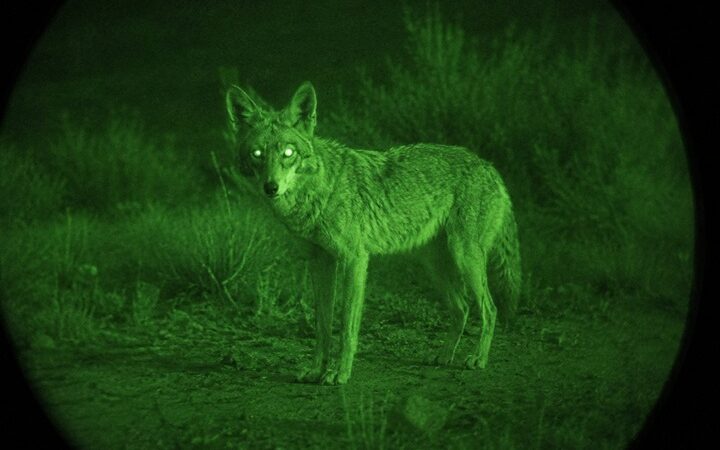
Point a regular camera into a pitch-black field and you get nothing but noise. Point a night vision device at the same field and suddenly there’s a fence line, a treeline, maybe a deer standing forty yards out. Nothing about the darkness changed. What changed is that the device found light your eyes couldn’t use and turned it into something they could.
The Core Idea Behind Night Vision Technology
Even in what seems like total darkness, there is almost always a small amount of ambient light present, and night vision cameras are engineered to capture and amplify that light until it becomes usable. This process is known as image enhancement, and it forms the foundation of most night vision systems.
In addition to light amplification, some systems rely on a completely different method called thermal imaging, which does not depend on light at all but instead detects heat differences between objects. Both approaches allow cameras to function in darkness, although they operate on very different principles.
Step-by-Step: How Light Becomes an Image
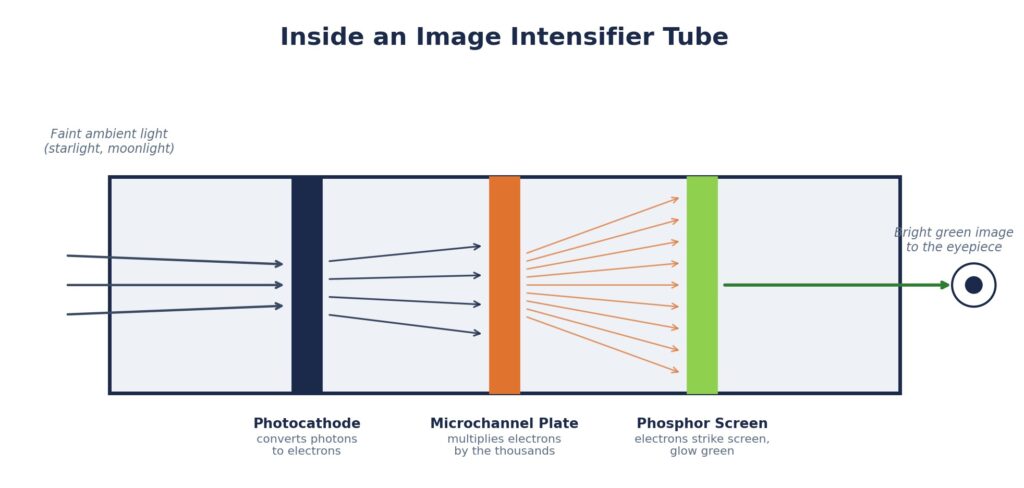
The process through which a night vision camera converts faint light into a visible image is both precise and layered, with each stage building upon the last to gradually increase brightness and clarity. A traditional night vision camera uses an image intensifier tube. Here’s how the process flows:
1. Light enters the lens
The camera lens collects any available light, including visible and near-infrared light.
2. Photocathode converts light to electrons
This light hits a component called a photocathode, a thin layer of material that reacts to photons (light particles) by releasing electrons. Each photon that lands knocks an electron loose, converting the incoming light into an electrical signal.
3. Electron multiplication
The electrons pass through a microchannel plate, a wafer packed with millions of tiny channels running through it. When an electron enters one of these channels, it collides with the channel walls repeatedly, and each collision knocks loose more electrons. One electron going in can trigger thousands coming out the other side. This is the actual amplification step, Where the image gains brightness, and it’s the reason a sliver of starlight becomes a workable image.
4. Phosphor screen creates the image
The amplified electrons strike a phosphor screen. The amplified electron stream then slams into a phosphor screen, which glows on contact, the same basic principle behind old CRT televisions, producing a visible image, usually in green, because the human eye detects green detail most effectively.
5. Final image output
The image is either viewed directly through an eyepiece or displayed digitally on a screen.
Infrared Illumination in Complete Darkness
When ambient light drops to extremely low levels or disappears entirely, night vision cameras compensate by introducing their own light source in the form of infrared illumination. This light is invisible to the human eye, yet it can be detected by the camera sensor, allowing the system to continue producing a clear image even in complete darkness.
This is why many security cameras are capable of showing detailed black-and-white footage at night, as they rely on infrared LEDs to illuminate the scene without drawing attention or disrupting the environment.
Thermal Imaging
Unlike traditional night vision, thermal imaging operates independently of light and instead focuses on detecting heat differences between objects. Every object emits a certain level of infrared radiation based on its temperature, and a thermal camera reads these variations and translates them into a visual representation.
Warmer objects, such as people or animals, appear brighter against cooler backgrounds, making them easy to identify even through obstacles like fog, smoke, or light vegetation. This capability makes thermal imaging particularly valuable in surveillance, search and rescue operations, and wildlife observation, where visibility conditions are often unpredictable.
Why Night Vision Images Are Usually Green
The distinctive green appearance associated with night vision devices is not simply a stylistic choice but a deliberate design decision based on how the human eye processes visual information. Since the eye can distinguish more shades of green than any other color, displaying images in green allows for finer detail recognition and reduces strain during prolonged use.
Although modern digital systems sometimes offer alternative color modes, green remains the most practical option for maintaining clarity and comfort.
Digital Night Vision vs. Traditional Systems
As technology has evolved, digital night vision cameras have become increasingly common, offering a different approach compared to traditional systems that rely on image intensifier tubes. Digital systems use advanced sensors and image processing algorithms to enhance low-light footage, making them versatile and suitable for both daytime and nighttime use.
While digital night vision tends to be more durable, affordable, and capable of recording video easily, traditional systems often perform better in extremely low-light conditions, where pure light amplification can still provide superior clarity.
Generations of Night Vision
Image intensifier tubes are graded by generation, and the gap between them is bigger than the naming suggests. Digital night vision skips the tube entirely and relies on a CMOS sensor paired with infrared illumination, which keeps costs down but leaves the device dependent on that illuminator in genuinely dark conditions. Gen 2 tubes use an improved photocathode and deliver noticeably better clarity and gain than digital setups, making them a common middle ground for hunters and property security. Gen 3 tubes step up to a gallium arsenide photocathode and add an ion barrier film that dramatically extends the tube’s working life, which is the main reason Gen 3 devices dominate professional and military applications despite carrying a steep price premium.
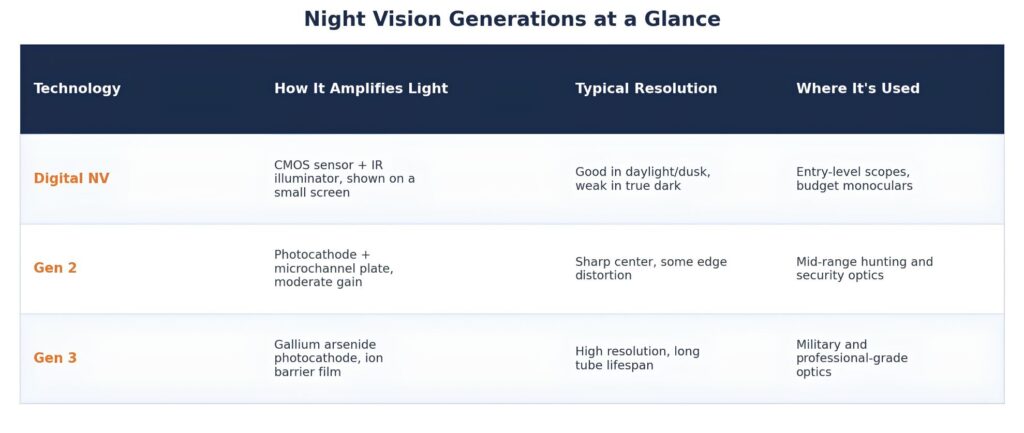 None of these generations is universally “better” for every buyer. A digital scope covering a barn at dusk doesn’t need Gen 3 performance, and paying for it would be wasted money. The generation question is really a question about how dark your actual use case gets and how much clarity you need at that darkness level.
Practical Uses of Night Vision Cameras
Night vision cameras are widely used across different fields because of their ability to operate reliably in low-light environments. These include;
- Security and surveillance – Monitoring homes, businesses, and public spaces
- Wildlife observation – Studying nocturnal animals without disturbance
- Military and law enforcement – Navigation and target identification
- Outdoor activities – Hunting, camping, and navigation
Final Thoughts
A night vision camera works by taking what little visual or thermal information exists in darkness and transforming it into a clear, usable image through a combination of light amplification, infrared illumination, or heat detection. By bridging the gap between human vision and the limits of darkness, these devices provide a powerful tool for seeing what would otherwise remain hidden, and as the technology continues to advance, their performance and accessibility are only improving. Understanding which approach a given device uses, and why, turns a confusing spec sheet into a straightforward decision.
Related