
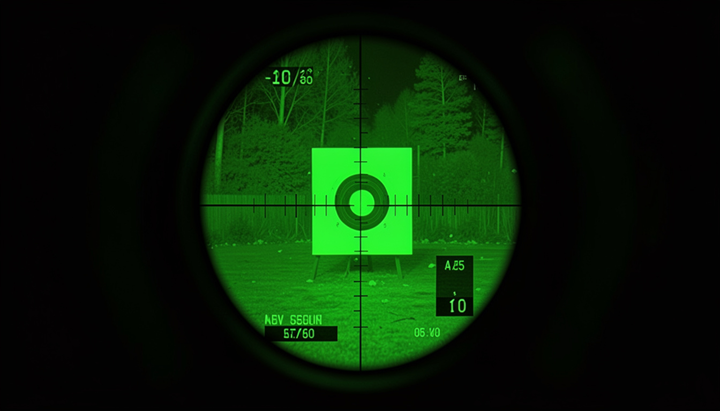
The under-$500 night vision scope market is almost entirely digital, and that’s not a compromise. If you’re coming from the world of image-intensifier tubes, yes, a Gen 2 or Gen 3 tube will outperform digital in raw sensitivity. But a Gen 2 tube scope that costs $500 is likely a beat-up surplus unit with a questionable tube. The digital scopes reviewed will outperform any Gen 1 tube scope in detection range and resolution.
What you’re trading is passive ambient light amplification. Digital night vision requires an active IR illuminator to be genuinely useful in pitch black. Get comfortable with that tradeoff, pair the scope with a quality external IR illuminator, and the performance ceiling at this price range is much higher than most expect.
In This Article
- Triton StarStrike Gen II 5-20x
- Sightmark Wraith 4K 4-32×40
- Sightmark Wraith HD 2-16×28
- Night Owl Optics NightShot II 3x40mm
- ATN X-Sight 4K Pro 3-14x
Best Night Vision Scopes Under $500- Reviews
1) Triton StarStrike Gen II 5-20x
View it on Amazon
|
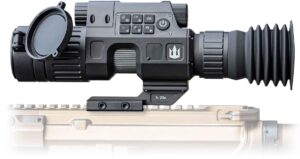
The Triton StarStrike Gen II 5-20x stands out as one of the best performers after sunset. While it isn’t designed to compete with high-end thermal optics costing several thousand dollars, it provides impressive nighttime visibility for its price.
The 5-20x magnification gives shooters plenty of flexibility. The built-in infrared illuminator extends usable viewing distance in complete darkness, allowing the scope to remain effective long after natural light has disappeared. During daylight hours, it also functions as a standard digital optic, eliminating the need to swap scopes between day and night hunts.
Another advantage is its user-friendly interface. The controls are straightforward, allowing quick adjustments without taking attention away from the target. The digital display produces a sharp image in favorable conditions, and the onboard recording capability lets users capture hunts or review shots afterward. This feature is particularly useful for hunters who enjoy documenting successful outings or evaluating their shooting technique.
Durability is another reason the StarStrike Gen II earns a place among the best night vision scopes under $500. Its rugged construction is built to handle recoil from common hunting rifles, while the weather-resistant housing adds confidence during damp evenings and changing outdoor conditions.
Battery life is the StarStrike’s biggest limitation, with only 120 minutes on medium settings. Triton includes two rechargeable batteries and USB-C charging, which helps, but you’re still managing power in ways the AA-powered Sightmark scopes don’t require. Swap one in, charge the other it works, but it adds a logistics layer to a full-night hunt.
Pros
- Excellent value for the price
- Versatile 5-20x magnification range
- Built-in infrared illuminator for complete darkness
- Functions in both daytime and nighttime conditions
- Onboard video recording capability
- Simple controls that are easy to learn
- Durable, weather-resistant construction
Cons
- Image quality decreases at maximum digital magnification
- Infrared illuminator has limited range compared to premium systems
- Digital display cannot match the clarity of high-end thermal optics
- Battery life isn’t the best
2) Sightmark Wraith 4K 4-32×40
View on Amazon and OpticsPlanet |
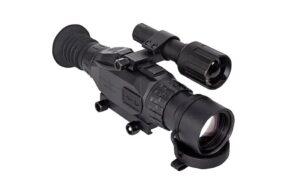
The Wraith 4K is what you get when Sightmark builds its flagship sensor into a scope priced at the ceiling of this budget. The 3840×2160 CMOS sensor is the highest-resolution in this roundup by a wide margin. During daylight, the image quality competes with traditional glass, color-accurate, sharp, without the visual fatigue that comes from a grainy or undersaturated digital display. That daytime performance isn’t a side feature; hunters running this scope in mixed conditions from pre-dawn to after-dark don’t have to accept degraded daytime optics.
At night, the 850nm IR illuminator provides a usable image out to 300 yards. That’s the rated spec, and field reports largely confirm it with the included illuminator, with one consistent caveat: at distances beyond 200 yards, the included 850nm torch starts showing limits. However, pairing the Wraith 4K with a quality aftermarket illuminator pushes clean identification range well past 400 yards.
The 4-32x range is the widest in this review. 32x on a digital sensor at night produces visible grain, and most users settle into the 8-16x zone for practical shooting. But the 4x low setting is genuinely useful for scanning at dusk and rapid target acquisition. Ten reticle styles with nine color options means you’ll find a combination that reads cleanly in any lighting condition.
Battery life is the recurring complaint about every Sightmark product, and the Wraith 4K is no exception. Three-and-a-half hours on video mode with AA batteries is limiting. The USB-C port allows an external battery pack to run it indefinitely in the field, which is the practical solution, but it’s an additional cost and physical setup. Hunters who exclusively sit feeders or fixed blinds won’t feel this as a problem; those who walk long setups will.
The 4K sensor, onboard 4K recording, dual-IR capability, wide magnification range, and IP55 weatherproofing form a package that costs two to three times more in competing brands.
Pros
- 4K CMOS sensor
- 4-32x magnification range
- 4K onboard video recording
- 10 reticle types, 9 colors
- Top Picatinny rail for external IR illuminator
- IP55 water resistant with aluminum construction
- USB-C external power compatible
Cons
- 6 hrs battery on AA (video mode)
- Digital grain visible past 20x
- Recoil rated to .308 Win only
- 6 oz with scope mount
- Included IR starts degrading past 200 yards
3) Sightmark Wraith HD 2-16×28
View on OpticsPlanet |
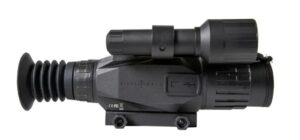
The Wraith HD 2-16×28 is the scope that converted a generation of skeptics on digital night vision. Before the 4K version existed, this was the Sightmark scope everyone recommended for budget hog and coyote hunters, and it still earns that recommendation for shooters who don’t need the full 4K treatment.
The 1920×1080 CMOS sensor delivers clear, detailed daytime imaging. The color mode reads like a small HD television, usable, accurate, and far better than the green-tinted imagery that older digital scopes produced. Night performance tops out around 200 yards with the built-in IR, which is an honest spec. The three-level IR intensity and adjustable beam width let you tune the illumination to your environment: narrow beam for distance work, wide spread for close scanning.
Where the Wraith HD earns its price is the 2x optical zoom foundation. Many digital scopes produce 100% digital magnification, every step involves a digital crop that degrades the image. The Wraith HD starts at 2x optical and stacks digital zoom from there, which gives the lower magnification settings noticeably better image quality than a pure-digital scope at the same zoom level. At 2x, you get a wide, clean field of view that works at close range. The digital degradation only becomes apparent at the upper 14x and 16x levels.
The 28mm objective is smaller than the 40mm objective on the Wraith 4K, and that shows in low-light passthrough, less light enters the sensor, which matters more when you’re pushing the IR hard. Pair this scope with a dedicated external IR illuminator if you’re regularly hunting past 150 yards in complete darkness.
Pros
- 2x optical base zoom
- Proven, long-standing user track record
- Three IR intensity levels, adjustable beam width
- Three display modes (Color / B&W / Green)
- Multiple weapon profiles saveable
Cons
- 200-yard detection ceiling with included IR
- 28mm objective limits passive light intake
- AA battery life is short on high IR
4) Night Owl Optics NightShot II 3x40mm
View on Amazon |
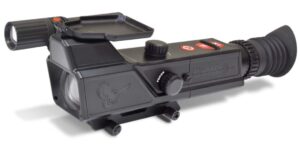
The NightShot II is the most honest scope in this roundup. It makes no attempt to be anything other than a budget night vision scope that gets the job done within its range.
Fixed 3x magnification is a real limitation. You cannot zoom in on a target or scan wide and then tighten up. What you see at 3x is what you get. At 150 yards with the built-in IR, the 640×480 sensor produces a clear enough image to identify a hog, coyote, or deer and make a confident shot. Past 200 yards, identification becomes unreliable without a stronger external IR illuminator.
The NightShot II’s redesign over the original introduced some meaningful upgrades: unlimited caliber compatibility an optimized 90-degree battery orientation for better balance, and an adjustable rail system that accommodates more rifle setups. Six reticle configurations, three styles each in black or white, cover the range of backgrounds and lighting conditions you’ll actually encounter.
Battery life is where the NightShot II gives the scopes a genuine advantage. Running 4-7 hours on 4x AA batteries with the IR active means you can get through a full night session without a battery change on a normal outing. Lithium AAs push that higher. You can also buy AA batteries at any gas station on the way to the field, which is a practical advantage no proprietary battery pack offers.
The thermoplastic body is lighter than aluminum, 20.8 oz is competitive, but it doesn’t convey the same durability. IPX4 weatherproofing handles splashing and light rain, not submersion. For a scope in the $299 range, that’s an acceptable spec.
Pros
- Lowest price in this roundup
- Unlimited caliber and crossbow compatibility
- 4-7 hr battery life on AA batteries
- Simple, low-learning-curve operation
- 6 reticle options (3 styles × 2 colors)
- Adjustable rail for custom positioning
- IPX4 weather resistance
Cons
- Fixed 3x magnification only
- 640×480 sensor
- 150-yard practical identification range
- No onboard recording capability
5) ATN X-Sight 4K Pro 3-14x
View on Amazon |
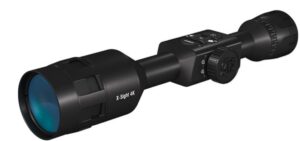
The ATN X-Sight 4K Pro 3-14x is built for hunters who want a single optic that performs in daylight and after dark. Its Ultra HD 4K sensor produces a sharp daytime image, while the included infrared illuminator provides clear night vision for hogs, coyotes, and other nocturnal game. The 3-14x magnification is well suited to typical hunting distances, offering a wide enough view for close encounters without sacrificing the ability to place precise shots farther out.
Beyond image quality, the X-Sight stands out for its smart features. One Shot Zero speeds up sight-in, the ballistic calculator helps with longer shots, and Recoil Activated Video records the moments before and after the trigger is pulled. Built-in Wi-Fi, Bluetooth, and video recording add value for hunters who like reviewing or sharing their hunts. The internal battery delivers long runtime, reducing the need to carry spare power packs on extended outings.
The trade-off is size and weight. At just over two pounds, it is noticeably heavier than a traditional riflescope, and the digital menu system takes time to learn. Even so, for hunters looking for a feature-rich day and night optic, the ATN X-Sight 4K Pro 3-14x offers excellent versatility and strong overall performance.
Pros
- Sharp 4K daytime image
- Clear night vision with included IR illuminator
- One Shot Zero simplifies sight-in
- Built-in ballistic calculator
- Recoil Activated Video captures every shot
- Wi-Fi and Bluetooth connectivity
- 18+ hour rechargeable battery
- Multiple reticle styles and color options
- Suitable for both day and night hunting
Cons
- Heavier than a conventional riflescope
- Digital interface requires a learning curve
- Digital zoom loses detail at higher magnification
Factors to Consider When Buying a Budget Night Vision Scope
Digital vs. Tube Night Vision
One of the first decisions is whether to choose a digital or traditional tube-based night vision scope. Digital night vision scopes dominate the budget market because they are more affordable, can be used during both the day and at night, and often include useful features such as video recording, Wi-Fi connectivity, ballistic calculators, and multiple reticle options. Tube-based night vision generally delivers a more natural image and better low-light performance, but it is significantly more expensive and is often limited to nighttime use. For most hunters looking for value, a digital night vision scope is the better investment.
Image Resolution
A higher-resolution sensor produces a clearer image, making it easier to distinguish between animals, vegetation, and other objects. This becomes especially important when hunting at longer distances or trying to identify game in dense cover. Budget scopes with HD sensors generally provide noticeably better detail than lower-resolution models, resulting in more confident shot placement.
IR Illuminator
An infrared (IR) illuminator is essential because it provides the invisible light needed for the scope to produce a clear image in complete darkness. A weak IR illuminator limits your effective range, while a more powerful unit improves image brightness and target identification. Some budget scopes include a basic IR illuminator that works well at moderate distances, while others allow you to upgrade to a stronger external illuminator for better performance.
Detection and Identification Range
Manufacturers often advertise impressive detection distances, but detecting an object is different from identifying it. A quality budget night vision scope should provide enough clarity to positively identify your target at the distances you normally hunt. For most hog and predator hunters, reliable identification at 150 to 250 yards is more valuable than exaggerated maximum detection claims.
Optical Magnification
Base optical magnification affects both field of view and image quality. Lower magnification, such as 2x or 3x, makes it easier to locate and track moving animals at close range. Higher optical magnification benefits longer shots but narrows your field of view. Choosing a scope with moderate optical magnification provides the best balance for most hunting situations.
Digital Zoom Performance
Many budget night vision scopes use digital zoom to extend magnification. While useful, digital zoom enlarges the image electronically, reducing sharpness as magnification increases. A scope with strong optical magnification will generally maintain better image quality than one that relies heavily on digital zoom.
Battery Life
Night hunts often last several hours, making battery life a major consideration. Rechargeable internal batteries can provide extended operating time, while scopes powered by AA batteries require carrying spares. A longer battery life means less interruption during a hunt and reduces the chance of losing power when game finally appears.
Refresh Rate and Image Smoothness
A higher refresh rate creates smoother image movement when tracking walking or running animals. A slow refresh rate can make moving targets appear choppy or blurred, making accurate shot placement more difficult. Even budget scopes should provide smooth image performance for typical hunting distances.
Recoil Rating
Not every night vision scope is designed for heavy-recoiling rifles. Before buying, verify that the scope is rated for the caliber you intend to use. A properly rated optic will withstand repeated recoil without losing zero or damaging its internal electronics.
Video Recording Features
Many hunters enjoy recording their hunts for later review or sharing with friends. Built-in video recording, audio recording, and recoil-activated recording can add considerable value without increasing the overall cost of the scope. These features are now common even on many affordable digital models.
Ease of Zeroing
A scope that offers quick and accurate zeroing saves both time and ammunition. Features such as one-shot zero allow you to adjust the reticle using a single shot, making the setup process much faster than traditional manual adjustments.
Build Quality and Weather Resistance
Night hunting often involves damp grass, rain, mud, and changing temperatures. A durable housing with water-resistant or waterproof construction protects the electronics and ensures dependable performance in challenging conditions. Rugged construction also helps the scope withstand rough handling in the field.
Weight and Size
Digital night vision scopes are typically larger and heavier than conventional riflescopes because they contain electronic components, batteries, and displays. While a heavier scope may not affect stationary hunting, it can become tiring during long walks or when carrying the rifle for extended periods. Choosing a compact model improves comfort without sacrificing essential performance.
Value for Money
The least expensive scope is not always the best buy. A well-designed budget night vision scope should combine good image quality, dependable battery life, useful features, and durable construction at a reasonable price. Spending slightly more for better optics and reliability often results in a scope that performs well for years instead of needing an early replacement.
Related