
Thermal imaging cameras were once strictly the domain of military units, HVAC contractors, and large industrial outfits with deep equipment budgets. That reality has changed dramatically. Today, a new wave of compact, affordable thermal cameras has made heat-vision technology accessible to hobbyists, homeowners, electricians, hunters, and outdoor enthusiasts alike. The challenge, however, is cutting through the noise of a crowded market to find a device that truly delivers without draining your wallet.
We’ve put together this guide to help you do exactly that. The cameras reviewed below were selected for their balance of resolution, sensitivity, build quality, and value, each one offering something genuinely useful at a price that won’t leave you wincing. Whether you’re chasing heat leaks in your home, tracking wildlife after dark, doing electrical diagnostics, or just want to explore the world through a different kind of lens, there’s something here for you.
In This Article
| Image | Product | View Price |
 |
TOPDON TC004 Mini | Amazon |
 |
FOXWELL RT280 | Amazon |
 |
Flagfront Thermal Camera | Amazon |
 |
HSFTools HF96 | Amazon |
 |
HIKMICRO E1L | Amazon |
 |
Thermal Master P1 | Amazon |
 |
TOPDON TC001 | Amazon |
Factors to Consider When Buying a Thermal Imaging Camera
- Thermal Resolution
Thermal resolution is one of the most important specifications to consider because it determines how much detail the camera can capture. Higher-resolution cameras produce clearer thermal images, making it easier to identify water leaks, electrical hotspots, insulation gaps, and mechanical problems. For most buyers, in the budget segment, a resolution of at least 160 × 120 is recommended, while 256 × 192 or higher provides noticeably sharper images and better overall performance.
- Thermal Sensitivity (NETD)
Thermal sensitivity measures the camera’s ability to detect small temperature differences. A more sensitive camera can reveal subtle temperature variations that may indicate hidden moisture, air leaks, or developing electrical faults. If leak detection or building inspections are a priority, choosing a camera with strong thermal sensitivity can make a significant difference.
- Refresh Rate
The refresh rate determines how smoothly the thermal image updates on the screen. A higher refresh rate reduces lag and makes it easier to scan walls, ceilings, equipment, and moving objects. While a 9Hz camera can be sufficient for occasional use, a 25Hz model generally provides a much smoother and more enjoyable inspection experience.
- Temperature Range
Every thermal camera has a minimum and maximum temperature range it can measure accurately. A wider temperature range makes the camera more versatile and suitable for a variety of applications, including home inspections, electrical troubleshooting, HVAC work, and automotive diagnostics. Always choose a camera that covers the temperatures you expect to encounter.
- Handheld vs. Smartphone Attachment
Thermal cameras are available as standalone handheld devices or smartphone attachments. Handheld models are convenient because everything is built into one unit, while smartphone thermal cameras are often more affordable, compact, and easy to carry. The best option depends on your budget, preferred workflow, and portability needs.
- Battery Life
Battery life is particularly important if you plan to perform lengthy inspections or use the camera frequently throughout the day. A camera with a longer battery life reduces interruptions and allows you to work more efficiently. This can be especially useful for contractors, technicians, and homeowners inspecting larger properties.
- Image and Video Recording
Many thermal cameras allow users to capture images and record videos for later review. This feature can be extremely helpful when documenting problems, creating inspection reports, or comparing temperature changes over time. If you plan to use thermal imaging regularly, recording capabilities are well worth having.
- Software Support
Good software can significantly improve the overall value of a thermal camera. Mobile apps and desktop programs make it easier to analyze images, create professional reports, track temperature measurements, and share findings with others. Cameras with strong software support often provide a better long-term user experience.
Best Cheap Thermal Imaging Cameras- Reviews
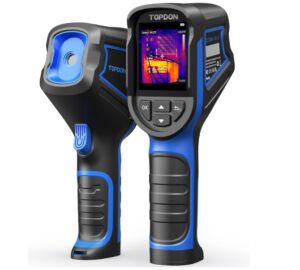
1) TOPDON TC004 Mini Thermal Imaging Camera
The TOPDON TC004 Mini is a compact thermal camera that punches well above its price class. It runs on its own built-in 2,900mAh battery delivering up to 15 hours of continuous runtime on a single charge, which is exceptional for a budget device and makes it a genuine field companion for full-day inspection work.
The native infrared sensor resolution is 128×128, enhanced via TOPDON’s TISR image processing technology to a displayed resolution of 240×240, giving you noticeably sharper thermal images than the raw sensor alone would produce. The camera features a 2.4-inch built-in display with a 25Hz refresh rate, delivering smooth, lag-free real-time imaging. Temperature measurement spans -4°F to 842°F (-20°C to 450°C) with ±3.6°F accuracy, and the thermal sensitivity is rated at <40mK, a genuinely impressive figure for this price tier.
The unit is IP54-rated for dust and splash resistance and has been drop-tested from 6.6 feet. Five color palettes, automatic max/min/center temperature detection, and a built-in high/low temperature alarm round out a well-considered feature set that makes this one of the strongest standalone budget thermal cameras available.
Pros
- Exceptional 15-hour battery life
- Strong <40mK thermal sensitivity at this price
- IP54 rated and 6.6ft drop-tested
- 25Hz refresh rate for smooth real-time imaging
Cons
- Native IR sensor is 128×128
- No laser pointer for precise target identification
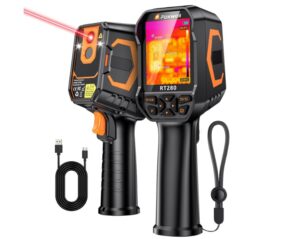
2) FOXWELL RT280 Thermal Imaging Camera
The FOXWELL RT280 offers a feature set that is difficult to match at its price point. Built around a 120 × 90 infrared sensor enhanced to 240 × 180 using TISR technology, it provides clear thermal images that are more than adequate for home inspections, automotive work, HVAC diagnostics, and electrical troubleshooting. The large 2.8-inch display makes thermal patterns easy to interpret, while the built-in laser pointer helps users quickly identify the exact area being measured.
One of the RT280’s biggest strengths is versatility. It includes photo and video recording capabilities, onboard storage, temperature alarms, and PC analysis support, features often missing from budget thermal imagers. The 25Hz refresh rate keeps images fluid when scanning large surfaces, and the wide field of view helps users inspect walls, roofs, engines, and electrical panels efficiently.
A dedicated LED light helps in low-visibility environments. PC analysis software is included for post-inspection image review and report generation, and 8GB of onboard storage means you won’t run out of space on a busy day. For a no-fuss, standalone camera with legitimate diagnostic range, the RT280 delivers.
Pros
- Large easy-to-read display
- Video and photo recording
- Built-in laser pointer and LED light
- 9 color palettes plus PC analysis software
- Smooth 25Hz refresh rate
Cons
- Thermal resolution trails higher-end models
- Bulkier than smartphone attachments
3) Flagfront Thermal Camera 240 × 240
The Flagfront Thermal Camera has become popular among budget-conscious buyers because it offers surprisingly clear thermal imaging at an affordable price. it delivers a 240×240 super-resolution output with a 25Hz refresh rate at a genuinely competitive price point, making it one of the sharper-looking budget cameras available without requiring a paired smartphone. The 50° field of view is generously wide, allowing you to cover larger surfaces in fewer sweeps, which makes real-world inspection faster and more efficient.
Temperature measurement runs from -4°F to 1022°F (-20°C to 550°C), a class-leading range that puts it ahead of several pricier standalone competitors, and measurement accuracy sits at ±2%. The camera auto-detects and displays highest, lowest, and center temperatures in real time, and the built-in temperature alarm flags when readings breach your preset thresholds, a practical feature for rapid anomaly triage.
Five color palettes let you adjust the display to suit different inspection contexts. The YXI96 is IP54-rated and drop-tested from 6.6 feet, so it can handle genuine fieldwork.
Pros
- Good 240 × 240 thermal resolution
- Easy to operate
- Compact handheld design
- Suitable for home inspections
- Affordable pricing
Cons
- Limited advanced analysis features
- Brand support is less established than major manufacturers
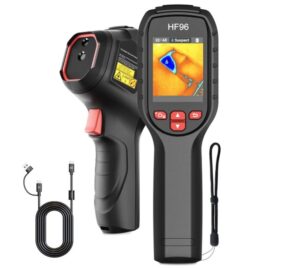
4) HSFTools HF96 Thermal Camera with AI Scene Detection
The HSFTools HF96 takes a genuinely inventive approach for a budget thermal camera by incorporating AI-assisted scene detection through HSFTOOLS’ proprietary IntellFault technology. Using deep learning, IntellFault automatically identifies and classifies the scene you are scanning, flagging water leak locations and insulation gaps without requiring you to manually interpret the thermal image.
For non-specialist users or those new to thermography, this feature dramatically reduces the learning curve and produces more actionable results faster. It is available via a firmware update downloadable from the HSFTOOLS website.
The HF96 has a native 96×96 infrared sensor enhanced to 240×240 via HSFTOOLS’ Live Super Resolution algorithm, with thermal sensitivity rated at <50mK and a 25Hz refresh rate. The unit combines a thermal camera, laser pointer, and thermometer in one compact device, and the 3,350mAh rechargeable battery provides up to 11 hours of runtime. Temperature measurement covers -4°F to 1022°F (-20°C to 550°C) with ±3.6°F accuracy.
With 4GB of internal storage and IP54 protection, the HF96 is a practical, intelligently designed tool that offers something genuinely different at this price, and the AI detection works well enough to be a meaningful advantage in the field.
Pros
- AI Scene Detection simplifies operation
- Beginner-friendly interface
- Good thermal detail
- Effective for leak detection
- Lightweight design
Cons
- Fewer advanced manual controls
- Less established brand reputation
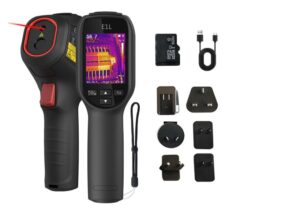
5) HIKMICRO E1L Thermal Imaging Camera
HIKMICRO is a name that carries genuine weight in professional thermal imaging circles, and the E1L represents the brand’s entry-level offering, one that manages to feel considerably more capable than its price implies. The E1L uses a 160×120 native infrared sensor, which is a true native resolution advantage over competitors that rely heavily on super-resolution upscaling to achieve their displayed pixel counts. Paired with a thermal sensitivity of <40mK the E1L resolves subtle temperature differences with a clarity that rivals cameras costing significantly more.
The temperature range spans -4°F to 1022°F (-20°C to 550°C) with ±2°C accuracy, and the 25Hz refresh rate delivers smooth live imaging. The 2.4-inch 320×240 LCD is readable and responsive, and the laser pointer helps you accurately identify the measurement point, which is especially useful during electrical panel inspections.
The integrated rechargeable battery delivers up to 8 hours of continuous use, and a microSD card slot supports cards from 8GB to 128GB for expanded storage. Backed by HIKMICRO’s professional engineering pedigree, a 3-year warranty on the device, and a 10-year warranty on the thermal sensor, the E1L offers a level of confidence that newer budget brands simply cannot match.
Pros
- 160×120 native IR resolution
- Exceptional <40mK thermal sensitivity
- Reputable brand with 3-year device and 10-year sensor warranty
- Wide -4°F to 1022°F temperature range
- Laser pointer for precise targeting
Cons
- 4-inch display is smaller than some competitors
- No visible-light camera or fusion imaging mode
- Expandable storage requires purchasing a microSD card separately
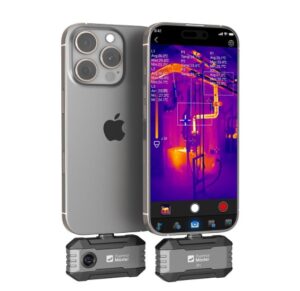
6) Thermal Master P1 Thermal Camera for USB-C
The Thermal Master P1 is a USB-C module thermal camera that turns your smartphone or computer into a capable thermal imaging station, and it covers a broader compatibility range than most in this category, working with USB-C iPhones, Android devices, and Windows PCs. The native infrared sensor is a 160×120 VOx detector, enhanced via the brand’s proprietary X³IR algorithm to a displayed resolution of 320×240, the highest effective output resolution of any camera in this roundup. Thermal sensitivity is rated at ≤40mK, which is excellent for a device at this price, and the 25Hz refresh rate ensures smooth real-time imaging.
The temperature measurement range is one of the widest available at -4°F to 1112°F (-20°C to 600°C), which extends beyond the 550°C ceiling of most budget competitors and makes the P1 genuinely viable for high-heat industrial or automotive applications. Accuracy is ±3.6°F (±2°C), and a 15× digital zoom allows close-up analysis of specific components.
The camera draws power directly from the host device, so there is no battery to manage, and the included 50cm extension cable allows you to inspect hard-to-reach areas without awkward phone positioning. At just 59×27×17.2mm, the P1 is exceptionally compact, small enough to keep in a toolkit at all times without noticing it is there.
Pros
- 320×240 resolution
- up to 1112°F (600°C) temperature range
- Compatible with USB-C iPhone, Android, and Windows PC
- ≤40mK thermal sensitivity
- Extremely compact
Cons
- No standalone display
- Draws from phone battery
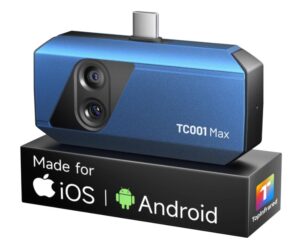
7) TOPDON TC001
The TOPDON TC001 is one of the best-selling smartphone thermal cameras for a reason. It combines a compact design with impressive thermal performance, making it an excellent option for users who want professional-looking thermal images without a professional price tag. The camera connects directly to a USB-C smartphone and delivers detailed thermal views suitable for electrical inspections, plumbing diagnostics, HVAC troubleshooting, and building inspections.
What sets the TC001 apart is its strong image quality relative to its size and cost. Small temperature differences are displayed clearly, making it easier to identify hidden problems before they become expensive repairs.
The accompanying app provides useful measurement tools, temperature tracking, and image recording features that expand the camera’s capabilities well beyond basic hotspot detection. Because it slips easily into a pocket, it’s a thermal camera that users are more likely to carry regularly. For anyone seeking an affordable yet highly capable thermal imaging solution, the TC001 remains one of the most compelling options available.
Pros
- Excellent thermal image quality
- Extremely portable
- Powerful companion app
- Ideal for home and professional use
- Great overall value
Cons
- Requires a compatible smartphone
- Not ideal for users wanting a standalone device
Frequently Asked Questions (FAQs)
How does a thermal imaging camera work?
A thermal camera uses an infrared sensor to detect heat emitted by objects. The camera then translates temperature differences into a colorized image, allowing users to quickly identify areas that are hotter or cooler than their surroundings.
Can thermal cameras see through walls?
No, thermal cameras cannot see through walls. They only detect heat on the surface of objects. However, they can reveal temperature patterns that may indicate hidden issues behind a wall, such as moisture, missing insulation, or overheating electrical components.
Do thermal cameras work in complete darkness?
Yes, thermal imaging cameras work perfectly in complete darkness because they detect heat rather than visible light. This makes them useful for nighttime inspections and low-light environments.
Related