

Picture yourself standing beside a tree line just after midnight. The wind has settled, the campsite is quiet, and something is moving beyond the reach of your ordinary binoculars. You can hear it, but you cannot make out its shape. This is where the best affordable night vision binoculars earn their place in an outdoor kit.
A reasonably priced digital night vision device gives you a way to observe wildlife, check a campsite perimeter, follow movement around a property, or scout an area after sunset without spending thousands on specialist equipment. However, expectations matter. These devices use electronic image sensors, digital displays, and infrared illuminators. They do not use Gen 2 or Gen 3 image-intensifier tubes, which amplify available light through a different technology.
In practice, that means you can see in complete darkness by switching on infrared illumination, but image detail depends heavily on the sensor, IR power, distance, and atmospheric conditions. Expect useful monochrome images, visible digital noise, and limited detail at longer distances. The seven models below offer different approaches, from straightforward observation to high-resolution video recording.
Quick Comparison
| Model | Display/resolution | Detection Range |
| BARSKA NVX100
|
320 × 240 display; 640 × 480 sensor | 328 ft / 100 m |
| AKASO Seemor-200
|
3-inch TFT; 4MP photos, up to 4K video | 1,640 ft wildlife observation; 3,280 ft landscape viewing |
| MOSSY OAK 4K
|
3-inch TFT; 4K video | 984 ft / 300 m |
| GTHUNDER 4K rechargeable
|
3.2-inch display; 4K video | 200- 300 m |
| WOSPORTS 4K
|
3-inch HD display; 4K video | 1,315 ft / 400 m |
| Nightfox Swift 2
|
480 × 360 display; 1920 × 1080 sensor | 130 m / 426 ft |
| Creative XP Pro
|
4-inch TFT display; capture resolution not confirmed | 100 m |
Best Affordable Night Vision Binoculars -Reviews
1) BARSKA BQ12388 Night Vision NVX100
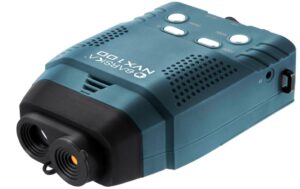
The BARSKA NVX100 takes a more traditional approach than the recording-heavy 4K devices in this roundup. Its compact housing, straightforward controls, and fixed 3x optical magnification make it a practical instrument for occasional nighttime observation. At approximately 8.7 ounces, it is also easy to carry in a jacket pocket or small outdoor bag. One important distinction is that this is a monocular, so you look through one eyepiece rather than using both eyes as you would with conventional binoculars.
Inside, a 1/5-inch CMOS sensor produces a 640 × 480 image, which appears on a 320 × 240 internal display. That is modest by modern digital camera standards, and fine details become difficult to distinguish as subjects move farther away. Its integrated 850nm, 3W infrared illuminator has a manufacturer-stated viewing distance of 328 feet. Treat that figure as an observation ceiling under suitable conditions rather than a promise of clear animal identification at that distance.
Unlike several newer rechargeable models, the NVX100 runs on four AA batteries. BARSKA specifies approximately two to five hours of battery life, depending on operating conditions. It also records still photographs and H.264 video to a microSD card, with USB and AV connections for transferring or displaying footage.
The strongest argument for this model is its uncomplicated operation and genuine optical magnification. Its biggest weakness is the low-resolution display, combined with the absence of weatherproofing. Buyers seeking an inexpensive, simple digital monocular for occasional backyard observation will understand its appeal. Those planning extended hunting trips or demanding wildlife identification should spend their money elsewhere.
Pros
- Genuine 3x optical magnification
- Compact and lightweight housing
- Records photographs and video
- Standard AA battery operation
- Built-in tripod mounting socket
Cons
- More of a monocular, not binocular
- Low-resolution internal display
- No waterproof protection
- Batteries are not included
2) AKASO Seemor-200 Night Vision Goggles

The AKASO Seemor-200 takes a different route from conventional infrared-only digital binoculars. Instead of relying exclusively on a black-and-white infrared image, it combines a large CMOS sensor with AI-assisted image processing to produce color images in very low light. That difference becomes immediately relevant when observing a field, woodland edge, or campsite where ambient light is still available.
Its 1/1.79-inch CMOS sensor is substantially larger than the small sensors commonly found in inexpensive digital night vision goggles. AKASO pairs it with a 3-inch TFT display and a claimed 4K video recording capability. Still photographs are specified at 4MP, so the 4K video label should not be mistaken for 4K still-image resolution. The device also provides a conventional infrared mode, using an adjustable seven-level 850nm illuminator when darkness becomes too deep for full-color imaging.
The manufacturer advertises 500m for observing wildlife and up to 1,000m for distinguishing large landscape features. Those are very different tasks: seeing a building outline across an open field does not mean identifying an animal at the same distance. Its 16x digital zoom also enlarges the existing image rather than adding optical detail.
Two removable 3,250mAh batteries provide up to eight hours of combined runtime, and USB-C charging makes field preparation straightforward. The device supports microSD storage up to 512GB and connects to the AKASO AURA application for file transfers.
Pros
- Large 1/1.79-inch CMOS sensor
- Full-color and infrared modes
- Up to 4K video recording
- Replaceable rechargeable batteries
- Supports up to 512GB storage
Cons
- Priced slightly above $200
- Digital zoom sacrifices detail
- Memory card sold separately
3) MOSSY OAK 4K Night Vision Goggles
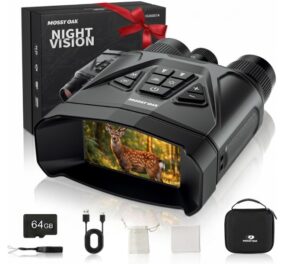
A large display and rechargeable battery make the MOSSY OAK 4K Night Vision Goggles an appealing choice for people who want to monitor their surroundings without constantly changing batteries. Its design focuses on straightforward digital observation, with a central focusing control, accessible operating buttons, and a 3-inch TFT screen. That screen is particularly useful when sharing observations with someone else or reviewing footage around a campsite.
This configuration advertises 4K video recording, 40MP photographs, and up to 12x digital zoom. For nighttime observation, the unit uses an 850nm infrared illuminator with seven adjustable brightness levels. Its advertised maximum viewing distance is 984 feet, or 300 metres. That is a manufacturer’s claim, not a dependable distance for identifying animals. At shorter distances, adjustable IR power gives you more control over brightness and helps avoid washing out nearby objects.
A built-in 5,000mAh rechargeable battery eliminates the recurring expense of disposable batteries. The specified package also includes a 64GB TF card, USB-C charging, and a tripod mounting point. The binoculars weights roughly one pound, making it better suited to handheld or tripod-supported observation than extended head-mounted use.
Pros
- Large 3-inch viewing screen
- Seven adjustable IR levels
- Rechargeable 5,000mAh battery
- 64GB storage card included
- Built-in tripod mounting point
Cons
- Digital zoom reduces image detail
- Approximately one-pound carrying weight
4) GTHUNDER Night Vision Goggles Binoculars 4K Rechargeable

The GTHUNDER rechargeable binoculars have the sort of layout that makes sense for someone who spends evenings observing wildlife or checking the surroundings of a property. The binocular-style body gives you a familiar grip, while the central screen keeps the image visible without requiring you to look through two conventional optical eyepieces. Manual focusing is straightforward, although getting a sharp picture of a moving subject takes some adjustment.
Its 3.2-inch display is generous enough for following movement, and the infrared system offers seven brightness settings. I particularly like having control over IR output because maximum illumination is not always the best setting. When an animal is relatively close, too much infrared can make its outline appear washed out. Reducing the brightness helps retain a more balanced image.
The rechargeable 4,000mAh battery is a practical advantage, especially for camping trips where carrying disposable batteries becomes inconvenient. With infrared switched on, expect considerably less operating time than during ordinary viewing without illumination. The included 32GB memory card is useful for recording observations, and USB-C charging makes topping up the battery relatively straightforward.
Pros
- Rechargeable 4,000mAh battery
- Seven adjustable infrared levels
- 32GB memory card included
- USB-C charging connection
- Advertised IP54 protection
Cons
- Native sensor resolution unconfirmed
- Limited runtime with IR enabled
- Relatively bulky housing
- Specifications differ between versions
5) WOSPORTS 4K Night Vision Goggles

The WOSPORTS 4K Night Vision Goggles are better suited to someone who prefers scanning an area from a stationary position rather than carrying a compact device during a long walk. The substantial binocular-style housing provides room for its display, controls, and rechargeable battery. Once you get comfortable with the focusing adjustment, it is reasonably straightforward to scan a field, woodland boundary, or campsite.
Its advertised 10x optical magnification is particularly interesting because it offers genuine enlargement through the optics rather than relying entirely on digital zoom. The additional 8x digital zoom brings subjects closer on the display, but image quality inevitably suffers as you push it higher. I would use the optical magnification for most observations and reserve digital zoom for situations where a little extra enlargement is necessary.
At night, the seven-level 850nm infrared system gives you flexibility when observing subjects at different distances. Its advertised maximum viewing distance is approximately 400 metres, although I would not expect reliable identification at that range. A moving animal against a dark background is much harder to distinguish than a large object in an open, unobstructed area.
The 5,000mAh rechargeable battery is one of its strongest practical features. You also get a 32GB memory card, with support for larger storage cards, so there is room for recording wildlife activity. USB-C charging makes preparation for another night outdoors easier.
My biggest reservation is the 4K video recording rate of 10fps. Moving animals can look noticeably less fluid in recorded footage than they would in a standard 30fps recording. The body is also bulkier than head-mounted alternatives. Still, for stationary wildlife observation and nighttime scouting, its combination of optical magnification and rechargeable power makes it an appealing choice.
Pros
- Advertised 10x optical magnification
- Adjustable seven-level IR illuminator
- Rechargeable 5,000mAh battery
- 32GB card included
- Expandable storage up to 256GB
Cons
- 4K recording limited to 10fps
- Relatively bulky housing
- Digital zoom reduces fine detail
6) Nightfox Swift 2 NVG Goggles
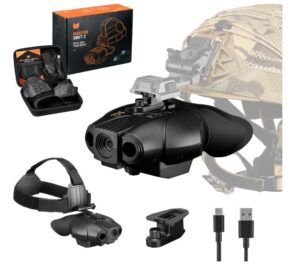
The Nightfox Swift 2 is the device I would reach for when moving around in the dark rather than sitting in one position watching distant wildlife. Its head-mounted design leaves both hands free, which makes a difference when walking around a campsite, checking equipment, or following a familiar trail after sunset. Once the head strap is properly adjusted, the device is more convenient for movement than a pair of bulky handheld digital binoculars.
The 2-inch display is relatively small, but it provides a usable picture without requiring you to hold anything in front of your face. Its 1080p sensor captures more image information than the display itself can show, so do not confuse the two resolutions. At 1x optical magnification, you get a broad view of your surroundings rather than a tightly enlarged picture. The 2x digital zoom helps bring nearby details closer, although it does not replace proper optical magnification.
The most interesting feature is its combination of 850nm and 940nm infrared illumination. The 850nm setting provides better reach, while the 940nm option produces less visible red glow around the illuminator. That is useful if you prefer a more discreet viewing setup, although the shorter infrared range means you sacrifice some distance.
I also appreciate the removable 3,200mAh 18650 battery. Carrying a spare is much easier than relying entirely on a fixed rechargeable system during a long outing.
The obvious compromise is that the Swift 2 does not record photographs or video. Its fixed 1x magnification also makes it unsuitable for detailed inspection of distant animals. However, it does its intended job well: providing hands-free digital night vision
Pros
- Lightweight head-mounted design
- Dual 850nm and 940nm illumination
- Removable rechargeable battery
- Wide 54-degree viewing angle
- Convenient hands-free operation
Cons
- No photo or video recording
- Fixed 1x optical magnification
- Limited digital zoom
- Shorter battery runtime than larger models
7) Creative XP Pro Night Vision Binoculars
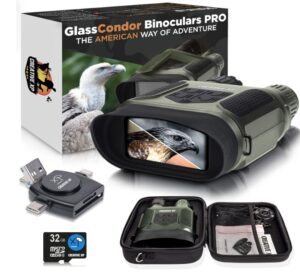
The Creative XP Pro is built for users who prefer watching a large internal screen rather than squinting through a small eyepiece. Its 4-inch TFT display gives the device a distinctive advantage during extended observation sessions. You have more screen space to follow movement, watch the edge of a property, or examine an area around a campsite without constantly adjusting your viewing position.
The controls and recording functions are geared towards general nighttime observation rather than specialist wildlife work. You can capture photographs and video, while the supplied 32GB SD card provides storage straight out of the box. I also like the practical accessory package, particularly the carrying case, which makes transporting and storing the binoculars easier.
The 2x digital zoom offers some additional enlargement, but it is not a substitute for optical magnification. As with other digital night vision devices, pushing the zoom too far makes the image less defined. This becomes particularly noticeable when trying to distinguish details on a distant animal rather than simply following its movement.
The large screen is both an advantage and a compromise. It makes viewing more comfortable, but it also makes the device less compact than lightweight head-mounted goggles. Screen brightness needs attention in a dark environment because excessive brightness can become distracting during prolonged observation.
The Creative XP Pro has an appealing layout for casual nighttime observation and recording. Its large screen and supplied accessories are its strongest selling points, but buyers who prioritize image detail and verified long-range performance should compare it carefully against the AKASO and WOSPORTS models.
Pros
- Large 4-inch TFT display
- Photo and video recording
- 32GB SD card included
- Protective carrying case supplied
- Useful accessory package
Cons
- Native sensor resolution unconfirmed
- Maximum IR range unverified
- Digital zoom offers limited detail
Buyer’s Guide: What to Look for in Affordable Night Vision Binoculars
Buying digital night vision is not simply a matter of choosing the device with the highest advertised range or the biggest resolution number. The difference usually comes from the following.
Infrared Range
A long infrared range looks impressive on a product listing, but it doesn’t tell you how clearly you’ll see an animal at that distance. Digital night vision relies on an infrared illuminator to light up the surroundings, while the sensor captures the reflected light and displays the image on a screen. The quality of that image depends on the sensor, IR power, weather conditions, vegetation and the size of the subject. A device advertised with a 400-metre range, for example, might detect movement at that distance without showing enough detail to identify the animal.
Pay attention to the difference between detection, recognition and identification. Detection means spotting movement, recognition means working out what you’re looking at, and identification means seeing enough detail to distinguish the subject. Adjustable IR brightness also matters because excessive illumination can wash out nearby objects, while insufficient power leaves distant subjects difficult to see. Prioritize useful image clarity over impressive range figures, particularly if you plan to use the binoculars for wildlife observation or night-time camping.
Digital Zoom vs. Optical Magnification
Optical magnification enlarges the subject through the lens before the image reaches the sensor, preserving more detail than digital zoom. Digital zoom simply enlarges the image already captured by the sensor, so increasing it often makes the picture look grainy or pixelated. You might spot an animal more easily at higher digital zoom, but that doesn’t mean you’ll see its features more clearly.
Check the advertised magnification carefully, especially on models promoting figures such as 10x, 20x or 80x. Some combine optical and digital zoom to produce a much larger headline number than the actual optical magnification. The BARSKA NVX100, for example, offers 3x optical magnification, while the Nightfox Swift 2 uses fixed 1x magnification. For clearer viewing, prioritize genuine optical magnification and treat digital zoom as a useful extra rather than a substitute for it.
Sensor Resolution and Display Resolution
Sensor resolution and display resolution describe two different parts of a digital night vision device. The sensor captures the image, while the display determines how that image appears through the eyepiece. Sensor size also affects light gathering. A high-resolution screen cannot restore details that a low-resolution sensor failed to capture, so advertised 4K recording or high-resolution displays don’t automatically guarantee sharper night-time viewing.
Check the native sensor resolution alongside the screen resolution and actual video recording quality. The BARSKA NVX100, for instance, uses a 640 × 480 sensor with a 320 × 240 display, which gives you a better indication of its imaging capabilities than a headline magnification figure.
Photo and Video Recording and Storage
Photo and video recording let you save wildlife sightings, review movement and share observations after a trip. However, recording features are not available on every model; the Nightfox Swift 2, for example, focuses on viewing rather than capturing footage. If recording matters to you, check the actual video resolution, frame rate, supported memory card capacity and whether a card is included.
Video resolution alone doesn’t tell the whole story because frame rate affects how smoothly moving subjects appear. A device recording 4K at 10 frames per second produces less fluid footage than one recording at 30 frames per second. Storage also fills quickly when recording high-resolution video, so occasional users can manage with a smaller memory card, while frequent recording calls for greater capacity. Focus on the quality of the footage and practical storage requirements rather than inflated megapixel claims.
Battery Life and Rechargeability
Battery performance becomes particularly important during camping trips, wildlife observation and extended night-time use, especially because infrared illumination places additional demands on the power supply. Rechargeable models offer a more convenient alternative, although their actual runtime depends on screen brightness, IR settings and recording activity.
That flexibility is useful during longer outings, particularly when charging facilities are unavailable. Before buying, check whether the advertised battery life includes continuous infrared use, since figures measured with IR switched off can give an overly optimistic impression of nighttime runtime.
Ergonomics, Weight and Handling
Night vision binoculars need to feel comfortable during the type of observation you intend to do. Traditional handheld models are generally better suited to stationary viewing, although their larger housings, screens and batteries can become tiring during extended use. Controls should also be easy to reach without forcing you to shift your grip or interrupt your view, while a tripod socket helps keep the image steady during longer observation sessions.
Head-mounted models such as the Nightfox Swift 2 offer hands-free viewing, which is useful when walking around a campsite or keeping your hands available for other tasks. However, the head strap, overall weight and screen position affect comfort, particularly during extended use.
Daylight vs. Night Performance
Some digital night vision binoculars support both daytime and nighttime viewing, making them more versatile for wildlife observation and outdoor activities. The AKASO Seemor-200, for example, supports full-colour viewing in low-light conditions alongside infrared night vision. However, performance in complete darkness depends on the infrared illuminator, since the device needs reflected IR light to produce a visible image.
It’s also important to distinguish digital night vision from thermal imaging. Digital night vision amplifies available light or uses infrared illumination to display the surroundings, while thermal devices detect differences in heat. This means digital night vision cannot reveal an animal hidden behind dense vegetation simply because its body produces heat. If your main priority is nighttime observation, focus on infrared performance and image clarity rather than treating daytime compatibility as the deciding feature.
Frequently Asked Questions (FAQs)
1. What are the best affordable night vision binoculars?
The AKASO Seemor-200 is the strongest overall imaging choice in this roundup. It combines a 1/1.79-inch CMOS sensor, full-color low-light imaging, infrared illumination, and up to 4K video recording. For hands-free observation, the Nightfox Swift 2 is a better choice.
2. Can cheap night vision binoculars work in complete darkness?
Yes. Digital night vision binoculars with built-in infrared illuminators can produce visible images in complete darkness. They illuminate the surroundings with infrared light, which the device’s sensor detects and displays as an image. Without sufficient infrared illumination, visibility and image detail decrease considerably.
3. How far can budget night vision goggles see?
The advertised range varies considerably between models. The BARSKA NVX100 specifies up to 100 metres, while WOSPORTS advertises approximately 400 metres. Actual performance depends on infrared power, sensor sensitivity, atmospheric conditions, and subject size. Detecting movement at a distance is not the same as identifying an animal.
4. Are 4K night vision goggles worth buying?
They can be, particularly if you want to record wildlife activity and review footage later. However, a 4K recording specification does not automatically mean the device has a native 4K sensor. Check sensor resolution, display resolution, and recording frame rate before paying extra for a 4K model.
5. Are digital night vision binoculars suitable for hunting and camping?
Yes. Digital night vision binoculars are useful for nighttime wildlife observation, campsite monitoring, and scouting. Rechargeable models are particularly convenient for extended outdoor trips. However, hunting with night vision equipment is subject to local laws and wildlife regulations, so check the applicable restrictions before using it for hunting.
Related
- Night vision binoculars coyote hunting
- Best thermal binoculars
- Best inexpensive night vision binoculars
- Best night vision binoculars for wildlife viewing