
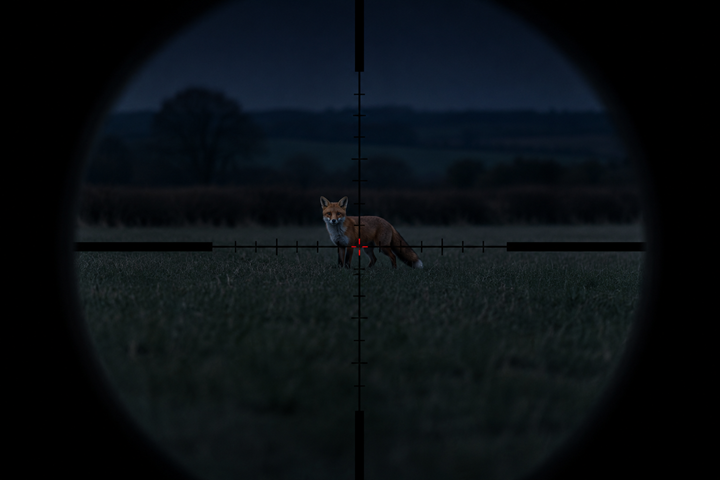
Fox hunting after dark demands more from a riflescope than simply allowing you to see in low light. Foxes are alert, fast-moving, and often appear for only a few seconds before disappearing into cover. A quality night vision scope should provide a sharp image, reliable target detection, a smooth refresh rate, and enough magnification to place an accurate shot without sacrificing field of view.
Modern digital night vision scopes also bring features such as video recording, ballistic calculators, laser rangefinders, and wireless connectivity, making them far more capable than older night vision systems.
Below are some of the best night vision scopes for fox hunting, each offering a different combination of image quality, features, and value.
In This Article
- ATN X-Sight 5 LRF 5-25x
- DNT Optics TNC225R ThermNight 256-25
- ATN X-Sight Pro 5-20x
- Sightmark Wraith 4K Mini 4-32×32
- AGM Global Vision Spectrum LRF 4K
- Night Owl Optics NightShot II with IR850-NS Illuminator
Night Vision Scopes for Foxing -Reviews
1) ATN X-Sight 5 LRF 5-25x
View on Amazon
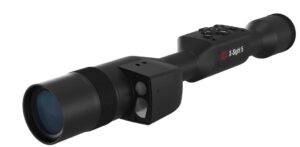
The ATN X-Sight 5 LRF 5-25x is one of the most feature-rich digital night vision scopes available today. Built around ATN’s latest generation platform, it combines high-resolution digital imaging with an integrated laser rangefinder, making distance estimation quick and accurate in complete darkness. For fox hunters who frequently shoot across open fields, this feature alone can dramatically improve shot placement.
Image quality is excellent during both daylight and nighttime use, especially when paired with a quality infrared illuminator. The wide magnification range makes it suitable for everything from close woodland encounters to longer shots across farmland. The built-in ballistic calculator works seamlessly with the laser rangefinder, automatically calculating the correct aiming point after measuring distance.
Video recording in 4K resolution is another major advantage. Every hunt can be recorded without attaching external cameras, while the recoil-activated recording function saves footage only when a shot is fired. Battery life is also significantly improved compared to previous X-Sight generations, allowing hunters to spend longer nights in the field without constantly worrying about charging. Overall, this scope is an outstanding choice for experienced fox hunters who want premium performance and advanced technology in a single optic.
Pros
- Integrated laser rangefinder
- Sharp daytime and nighttime image quality
- Built-in ballistic calculator
- Excellent 4K video recording
- Long battery life
- Smooth user interface
Cons
- Premium price
- Larger and heavier than simpler digital scopes
2) DNT Optics TNC225R ThermNight 256-25
View on Amazon
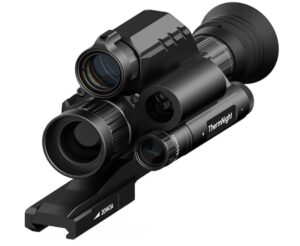
The DNT Optics TNC225R ThermNight is one of the most innovative optics available for fox hunters because it combines thermal imaging and digital night vision in a single scope. Instead of choosing between the superior detection of thermal and the detailed target identification of night vision, the TNC225R lets you use both at the same time through its picture-in-picture display. This is a major advantage when hunting foxes, as thermal quickly reveals an animal hidden in grass or brush, while the digital night vision channel helps confirm that the target is indeed a fox before taking the shot.
The digital night vision system uses a Sony STARVIS 2 sensor that produces a clear color image during the day and a detailed monochrome image at night. The built-in 850nm infrared illuminator provides effective illumination for typical fox hunting distances, and the scope also includes a laser rangefinder capable of measuring distances out to 1,000 meters. Combined with the onboard ballistic calculator, this makes longer shots much more precise.
Despite its compact size, the TNC225R is packed with useful hunting features. It offers onboard photo and video recording, Wi-Fi and Bluetooth connectivity, one-shot zeroing, multiple display modes, and removable 18650 rechargeable batteries that are easy to replace in the field. The thermal sensor has a 256 × 192 resolution, which is lower than premium thermal scopes, but it remains highly effective for detecting foxes while the night vision channel supplies the detail needed for positive identification. For hunters looking for the versatility of both technologies without paying the price of two separate optics, the TNC225R is an outstanding value.
Pros
- Combines thermal imaging and digital night vision
- Picture-in-picture mode
- Built-in laser rangefinder and ballistic calculator
- Clear daytime and nighttime digital image
- Onboard photo and video recording
- Compact, lightweight design
- Replaceable 18650 battery
Cons
- 256 × 192 thermal resolution is lower than premium thermal scopes
- Startup time is slower than some competing optics
- Thermal image is less detailed than higher-resolution 384 or 640 thermal models
3) ATN X-Sight Pro 5-20x
View on Amazon
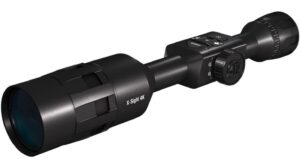
The ATN X-Sight Pro 5-20x delivers many of the advanced capabilities found in higher-end digital optics while maintaining a practical magnification range for fox hunting. The scope produces crisp images during daylight and provides impressive nighttime performance when used with a good infrared illuminator.
One of its biggest strengths is its intelligent feature set. Hunters benefit from a ballistic calculator, multiple reticle choices, video recording, wireless connectivity, and recoil-activated recording. These features make the scope useful not only for hunting but also for reviewing shots and improving shooting technique.
The 5-20x magnification range is particularly well suited to fox hunting because it provides enough magnification for longer shots without becoming difficult to manage at closer distances. Navigation through the menus is intuitive, allowing quick adjustments even while wearing gloves.
For hunters who want advanced technology without stepping into the highest price bracket, the X-Sight Pro offers an excellent balance of performance and value.
Pros
- Excellent digital image quality
- Useful smart hunting features
- Integrated video recording
- Good magnification range for fox hunting
- User-friendly controls
Cons
- Performs best with a quality external IR illuminator
- Digital zoom reduces image clarity at maximum magnification
4) Sightmark Wraith 4K Mini 4-32×32
View on Amazon
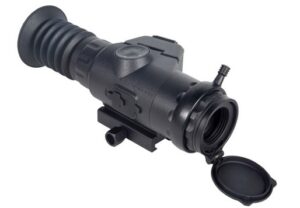
The Sightmark Wraith 4K Mini has earned a strong reputation among predator hunters because it delivers impressive image quality in a remarkably compact package. Unlike many full-sized digital scopes, the Wraith 4K Mini keeps overall weight low, making it ideal for hunters who spend long nights walking between calling locations.
Its 4K CMOS sensor produces a noticeably sharp daytime image, while nighttime performance remains excellent when paired with the included infrared illuminator or an upgraded aftermarket unit. The 4-32x digital magnification provides flexibility for both short- and medium-range fox hunting.
The compact design also makes rifle handling feel more natural compared to heavier digital optics. Video recording with audio allows hunters to capture memorable hunts without carrying additional equipment, and the straightforward controls are easy to learn. The Wraith 4K Mini is one of the strongest options in its class, for hunters wanting modern digital performance in a lightweight scope.
Pros
- Compact and lightweight
- High-resolution 4K sensor
- Excellent daytime performance
- Easy-to-use interface
- Video recording with audio
- Good value for money
Cons
- Digital zoom softens image at higher magnification
- IR illumination range depends on the illuminator used
5) AGM Global Vision Spectrum LRF 4K
View on Amazon
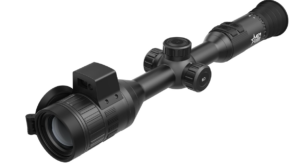
The AGM Global Vision Spectrum LRF 4K combines a high-resolution 4K sensor with an integrated laser rangefinder, creating a capable hunting optic designed for serious predator hunters. The scope produces detailed images during daylight while delivering excellent nighttime visibility with an infrared illuminator.
The built-in laser rangefinder is particularly useful for fox hunting because distance estimation at night is often difficult. Accurate ranging allows hunters to make more confident shots across fields or pastureland where judging distance by eye can be challenging.
The scope includes onboard video recording, multiple reticle options, wireless connectivity, and ample onboard storage for recording hunts. Image processing is fast, resulting in smooth viewing while tracking moving animals. Its rugged construction also inspires confidence when hunting in poor weather conditions.
Hunters looking for premium imaging, dependable ranging capability, and modern digital features will find the Spectrum LRF 4K to be a highly capable night hunting optic.
Pros
- Integrated laser rangefinder
- High-resolution 4K sensor
- Excellent daytime clarity
- Smooth image processing
- Video recording
- Durable construction
Cons
- Heavier than entry-level digital scopes
- Premium pricing
6) Night Owl Optics NightShot II with IR850-NS Illuminator
View on Amazon
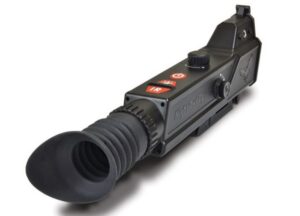
The Night Owl Optics NightShot II with the IR850-NS Illuminator is an excellent choice for fox hunters who want to get into night hunting without spending premium money. While it lacks many of the advanced features found on high-end digital scopes, it delivers dependable night vision performance at typical fox hunting distances, making it an attractive option for beginners and budget-conscious hunters.
The included IR850-NS infrared illuminator projects an 850nm beam that noticeably improves image brightness and target identification in complete darkness. Under good conditions, it provides enough illumination for confidently identifying foxes inside practical shooting ranges, particularly around bait sites, field edges, and pastureland.
Operation is refreshingly straightforward. The controls are simple to learn, allowing hunters to spend more time watching for movement than navigating complicated menus. Unlike many modern digital scopes, the NightShot II focuses on core functionality rather than packing in features such as ballistic calculators, Wi-Fi, or onboard video recording. For many hunters, that simplicity is actually an advantage.
The image quality cannot match today’s premium 4K digital optics, particularly at longer distances, but within its effective range it provides enough detail to identify foxes and place accurate shots. Hunters who mainly shoot over shorter distances and want an affordable, easy-to-use night vision setup will find it offers solid value for the money.
Pros
- Affordable entry into night vision hunting
- Includes the IR850-NS infrared illuminator
- Straightforward controls with a short learning curve
- Lightweight compared to many premium digital scopes
- Well suited to short- and medium-range fox hunting
Cons
- Image quality is behind modern 4K digital scopes
- Lacks video recording and advanced smart features
- Limited effective range compared to premium models
- Fixed magnification offers less versatility than variable-power optics
What to Consider Before Buying
Image Quality
Image quality is one of the most important factors when choosing a night vision scope for fox hunting. A sharp, high-resolution image allows you to distinguish a fox from tall grass, bushes, fence posts, or other animals, even in poor lighting. Better image quality also makes it easier to identify your target before taking a shot, which is essential for safe and ethical hunting. Keep in mind that increasing digital magnification can reduce image sharpness, so a scope with a high-quality sensor will generally produce a clearer picture throughout its zoom range.
Infrared Performance
Most digital night vision scopes depend on an infrared (IR) illuminator to provide a usable image in complete darkness. Think of the IR illuminator as a flashlight that the scope can see but the human eye cannot.
A stronger, higher-quality IR illuminator allows you to detect foxes at greater distances and reveals more detail in their shape and movement. Some scopes include a basic illuminator, while others perform even better when paired with a more powerful aftermarket IR light. The quality of the illuminator can make a significant difference to your nighttime visibility.
Magnification
The right magnification depends on where you hunt. Lower magnification provides a wider field of view, making it easier to spot a fox that suddenly appears or is moving across your line of sight. Higher magnification is useful when taking longer shots across open fields because it lets you see more detail. However, very high digital magnification often enlarges the image without adding detail, resulting in a softer or grainier picture. For most fox hunting situations, a moderate base magnification with enough zoom for longer shots offers the best balance between visibility and precision.
Battery Life
Night hunts often last several hours, and a digital scope stops being useful once its battery is depleted. Look for a model with enough battery life to comfortably cover an entire hunting session. Rechargeable internal batteries are convenient, but it’s also worth considering whether the scope can be powered by an external USB power bank. This can be a major advantage during extended hunts, allowing you to continue hunting without waiting for the battery to recharge.
Laser Rangefinder
Judging distance accurately at night is much harder than during the day because familiar landmarks are often difficult to see. An integrated laser rangefinder measures the exact distance to your target with the press of a button, removing much of the guesswork.
This becomes especially valuable when hunting foxes across open farmland or large fields, where even small errors in distance estimation can affect shot placement. If the scope also includes a ballistic calculator, it can use the measured distance to calculate the correct point of aim, making long-range shots more accurate and consistent.
Durability
If you want your night vision scope to give many years of use, make sure that it is built with high-quality materials. You will be spending a large amount of money on a single product, so you will want it to give you great value for your money.
Look for a scope that is crafted with high-quality materials such as aluminum or magnesium alloy. For greater durability, make sure that the scope is shockproof and recoil-resistant. It’s also wise that you get a scope that’s is both waterproof and fog-resistant
Frequently Asked Questions (FAQs)
Can you hunt foxes with a night vision scope?
Yes. Night vision scopes are widely used for fox hunting because foxes are primarily active after sunset. A quality night vision scope allows hunters to identify their target, observe its movements, and make accurate shots in low-light or complete darkness. Always check your local hunting regulations, as laws regarding nighttime hunting and night vision equipment vary by location.
What is the difference between a night vision scope and a thermal scope?
A night vision scope uses available light and infrared illumination to produce an image, allowing you to see details such as the animal’s shape, fur, and surroundings. A thermal scope detects heat rather than light, making warm-bodied animals stand out regardless of lighting conditions. Night vision generally provides better target identification, while thermal excels at detecting animals hidden in vegetation.
How far can a night vision scope see?
The range of a night vision scope depends on its sensor, the quality of its infrared (IR) illuminator, weather conditions, and the amount of ambient light. Most entry-level digital night vision scopes can clearly identify foxes at 100 to 200 yards, while mid-range models typically extend that to 200 to 350 yards. Premium 4K night vision scopes paired with a powerful IR illuminator can often identify foxes at 400 to 500 yards or more under ideal conditions.
Keep in mind that detecting an animal is easier than identifying it. While you may spot movement much farther away, being able to confirm it is a fox and take a safe, ethical shot usually requires a shorter distance.
Do all night vision scopes require an infrared illuminator?
Most digital night vision scopes perform best with an infrared illuminator during complete darkness. Some scopes include one in the box, while others allow you to upgrade to a more powerful illuminator for increased range and image clarity.
Can a night vision scope be used during the day?
Most modern digital night vision scopes are designed for both daytime and nighttime use. They automatically display a color image during the day and switch to night mode in low-light conditions, making them useful for hunting at any time.
Is 4K resolution worth it on a night vision scope?
A 4K sensor generally provides a sharper image, better detail, and improved digital zoom performance compared to lower-resolution sensors. This can make it easier to identify foxes at longer distances and distinguish them from other animals or objects.
What magnification is best for fox hunting?
A base magnification between about 3x and 5x works well for most fox hunting situations because it offers a wide enough field of view while still providing sufficient detail. Variable magnification gives hunters the flexibility to engage foxes at both close and longer distances.
Does digital zoom reduce image quality?
Yes. Digital zoom enlarges the existing image rather than using optical lenses to magnify it. As a result, image sharpness usually decreases as digital magnification increases, especially at the highest zoom settings.
Is a laser rangefinder useful for fox hunting?
Yes. A laser rangefinder helps determine the exact distance to a fox, reducing guesswork during nighttime hunts. This is especially beneficial when hunting across open fields, where accurately estimating distance can be difficult.
How important is battery life in a night vision scope?
Battery life is very important because fox hunting often involves spending several hours outdoors after dark. Choosing a scope with long battery life—or one that can be powered by an external USB power bank, helps ensure your hunt is not cut short.
What time are foxes most active?
Foxes are generally most active from dusk until dawn. Activity often increases shortly after sunset and again during the hours before sunrise, although foxes may remain active throughout the night depending on food availability and local conditions.
Where should you look for foxes at night?
Foxes commonly travel along field edges, hedgerows, fence lines, woodland borders, livestock pastures, and areas with abundant rodents or rabbits. Watching these travel routes can greatly improve your chances of spotting one.
How Close Can You Get to a Fox?
How close you can get to a fox depends on factors such as wind direction, terrain, and how alert the animal is. In open ground, a fox may detect you from 100 yards or more if it catches your scent or sees movement. With good concealment, minimal movement, and the wind in your favor, experienced hunters can sometimes get within 30 to 50 yards before the fox becomes aware of their presence.
What weather is best for fox hunting?
Cool, dry nights with light winds are generally ideal. Strong winds can make it harder to hear approaching foxes and may carry your scent toward them, while heavy rain or dense fog can reduce visibility and the performance of night vision equipment.
Can moonlight improve night vision performance?
Yes. Bright moonlight provides additional ambient light, which often results in a clearer image through a night vision scope. On darker, moonless nights, a quality infrared illuminator becomes much more important.
How Night Vision Works
Night vision scopes collect and intensify the ambient light from the moon and stars to form an image at night. Some night vision scopes have an infrared illuminator that you use to identify the targets at night.
This light is invisible to the human eye, but you can use it to create a viewable image even in total darkness. Night vision devices use either an image intensifier tube or a camera sensor to produce a viewable image.
Traditional Vs Digital Night Vision
Most military forces use devices with traditional night vision technology. These devices are only used in the dark and are categorized by generations from Gen 1 to Gen 3.
Read: Generations of Night Vision (Gen 0-4)
Gen 1 is the most basic and cost-effective technology. However, Gen 1 devices don’t offer good image clarity like Gen 2 and Gen 3 devices. Image clarity, battery life, and detection range increase as the technology improve.
On the other hand, digital night vision is a new technological development. These devices use an objective lens, a charger coupler tool, and an LCD screen that transmits the digital image to the user.
The images are displayed in black-and-white unlike the green hue of traditional night visions. These modern devices are both day and night time capabilities. They also tend to be more affordable.
Final Verdict
Each of these scopes is capable of producing excellent results, but they serve slightly different types of hunters.
The ATN X-Sight 5 LRF 5-25x stands out for hunters wanting the most complete package, combining excellent imaging, an integrated laser rangefinder, a ballistic calculator, and advanced recording features.
The ATN X-Sight Pro 5-20x offers an impressive mix of smart features and performance while remaining slightly more affordable.
Hunters who prioritize lightweight handling should consider the Sightmark Wraith 4K Mini 4-32×32, which offers outstanding portability without sacrificing image quality.
Finally, the AGM Global Vision Spectrum LRF 4K is an excellent premium option for hunters who value outstanding image quality, reliable ranging capability, and rugged construction for demanding nighttime predator hunting.
Related