

If you’re looking to explore the night without breaking the bank, a night vision monocular is one of the best gadgets you can invest in.
Unlike bulky binoculars or expensive scopes, night vision monoculars are easy to carry, simple to use, and surprisingly affordable for beginners and hobbyists. Modern digital monoculars often include features like, photo and video capture, adjustable brightness, and infrared illumination giving you a clear view even in total darkness.
Choosing the best one for the money means finding a balance between performance, durability, and price.
In this guide, we’ll explore the best night vision monoculars that give you real value without compromising quality.
Lets start with a recap;
- Sightmark Wraith 4K 1x
- Bushnell Equinox EX650 5x 32mm – Best Budget
- AGM Global Vision PVS-14 1×26 mm
- TRYBE Optics GEN 3 PVS-14
- SiOnyx Aurora Pro
- ATN PVS14‑3 1×27 mm
Best Night Vision Monocular for The Money -Reviews
1) Sightmark Wraith 4K 1x Monocular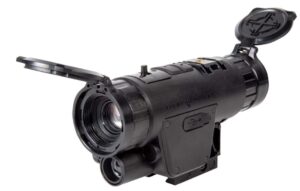
The Sightmark Wraith 4K 1x Monocular brings together day and night usability in a compact digital package. It uses a 4K CMOS sensor for strong image detail and clarity, while the built-in display (1280×720) offers a crisp viewing experience. During the day you see in full color, and with a quick mode switch it becomes digital night vision for darkness.
Detection range is decent at 300 yards, and the 1–8× digital zoom, gives flexibility for scanning wide areas or zooming in to inspect something closer. The integrated 850 nm IR illuminator automatically adjusts brightness, helping you maintain a clear picture when ambient light is low.
The unit also records photos and videos, including 4K footage, directly to a microSD card up to 256 GB. Power comes from two CR123A batteries or a USB-C external power source, which is useful when you need extended operation.
Built with an aluminum body, IPX6 water-resistance, and shock protection rated for minor drops and up to .308-caliber recoil, it’s ready for field use whether handheld, helmet-mounted, or weapon-mounted.
Pros
- Sharp, high-resolution 4K image
- Works for handheld, helmet, or weapon use
- Built-in photo and video recording
- Effective IR illuminator for dark environments
- Good value compared to higher-end NV gear
Cons
- Digital zoom reduces clarity
- Battery life can drop quickly with IR on
2) Bushnell Equinox EX650 5x32mm
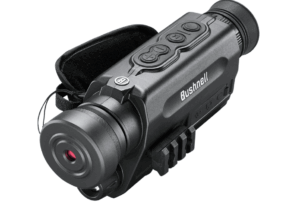
If you want a solid night vision monocular at a budget friendly price, then it doesn’t get better than the Bushnell Equinox EX650 5-32x. Its 5x optical magnification provides a good balance between detail and stability, while the 32mm objective lens allows enough light for clearer digital images at short to mid-range distances.
The built-in IR illuminator, enhances its capability in low light and complete darkness, and you get a 650-foot viewing range in the dark. This makes it pretty useful for a variety of tasks such as security checks, wildlife viewing and varmint hunting.
Additionally, the device offers digital zoom, video recording capability, and a straightforward button layout that is easy to navigate even in the dark. Its rugged housing feels durable, and the battery life is acceptable for casual use.
Although the EX650 cannot match the clarity or long-range power of more advanced night vision systems, it performs reliably for its class and is an excellent entry-level choice.
Pros
- 5x magnification with clear mid-range performance
- Effective built-in IR illuminator
- Durable build and simple controls
- Video recording and digital zoom
Cons
- Limited long-range clarity
- Image softens without IR assistance
3) AGM Global Vision PVS-14 1×26 mm
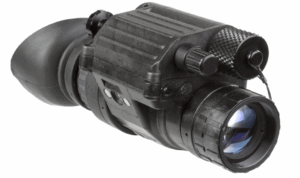
The AGM Global Vision PVS-14 1×26 mm Night Vision Monocular is an analog Gen-2+, military-grade device originally commissioned for combat use, and its design still reflects that pedigree. Its also compact and can easily fit into a small bag.
With 1x magnification, it preserves a natural field of view, allowing easy movement and target recognition in the dark. Its 26 mm objective lens gathers enough light to deliver bright, sharp images even in extremely low-light conditions.
The monocular includes manual gain control, so you can adjust the brightness to see details clearly in different lighting conditions. It also has a bright light shut-off feature, which protects the image tube from damage when exposed to sudden or strong light.
Though it lacks magnification and pricier than the digital models, its reliability, clarity, and combat-proven design make it one of the most trusted night vision monocular available.
Pros
- Military-grade analog performance
- Brightness shut off feature
- Natural 1x view for easy movement
- Rugged, field-ready construction
- Helmet-mountable for hands-free use
Cons
- No magnification for long-range viewing
- Pricier
4) TRYBE Optics GEN 3 PVS-14 Night Vision Monocular
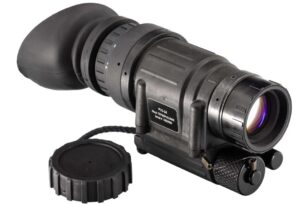
The TRYBE Optics GEN 3 PVS-14 Night Vision Monocular stands out as a reliable, field-ready tool for anyone who needs true low-light performance rather than basic digital night vision.
Built around a Gen-3 image intensifier, it delivers bright, detailed views even when natural light is almost gone. Its 1× magnification keeps the image natural and easy to navigate, while the 27 mm f/1.2 objective lens and roughly 40° field of view provide a wide, comfortable picture that works well for movement, scanning, or close-range tasks.
The unit includes useful analog features like diopter adjustment for personal clarity and gain control for fine-tuning brightness. A built-in IR illuminator helps in pitch-dark areas, and the device runs on a single AA battery, offering around 40–50 hours of use.
Its rugged, water-resistant housing meets field durability standards, and it can be used handheld or mounted on a helmet, making it very adaptable for outdoor activities, security work, or nighttime navigation
Pros
- Strong Gen-3 low-light performance
- Natural 1× view with wide field of vision
- Adjustable gain and diopter for personalized clarity
- Long battery life with a single AA
- Helmet-mountable and durable for field use
Cons
- Depends on IR in extremely dark environments
- Bulkier than smaller digital monoculars
5) SiOnyx Aurora IR Night Vision Monocular
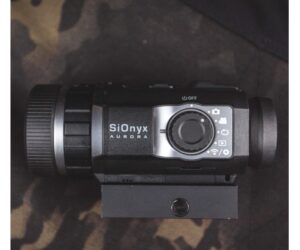
The SiOnyx Aurora IR Night Vision Monocular is a digital night vision monocular with full color capabilities, and can detect a human-sized target at around 150 m under quarter-moon conditions.
It uses an ultra‑low‑light sensor and a 16 mm f/1.4 lens to let you see in near‑dark conditions, even under starlight or minimal ambient light. It can display in color when light allows, or switch to monochrome when darkness grows, which makes the view feel more natural than classic “green‑tinted” night vision.
You get digital zoom from 1× to about 3×, and a wide, comfortable field of view, and a diopter adjustment from –4 to +4, so you can fine-tune focus to match your eyesight.
you can record video or take photos, store them on a memory card (256GB), and even stream live video to your phone using its built-in Wi‑Fi. The housing is weather- and dust‑resistant (IP67 rated) so rain, dust or splashes won’t ruin it, which makes it handy outdoors. Moreover, it can work handheld, or be mounted on a tripod or rail.
Pros
- Clear color or black-and-white night vision
- Easy to use and lightweight
- Weather-resistant and records photos/videos
- Simple zoom for close to mid-range viewing
Cons
- Needs extra IR in total darkness
- Shorter detection range
- Digital zoom reduces image sharpness
6) ATN PVS14‑3 1×27 mm Night Vision Monocular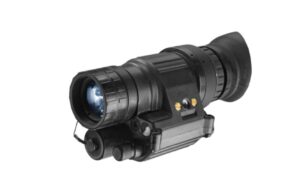
The ATN PVS14‑3 1×27 mm Night Vision Monocular uses a Gen‑3 image intensifier tube, which gives strong performance in low light and produces a clear, bright night image. With 1× magnification, it shows what you see naturally no zoom, just a wide, clean view.
The 27 mm, f/1.2 lens and a 40° field of view give you a broad perspective, handy when moving around or scanning an area. The focus goes from about 0.25 yards to infinity, so you can see things close up or far away without trouble. There’s also a diopter adjustment from –5 to +2, letting you sharpen focus to match your eyesight.
In good low‑light conditions you can expect usable vision of people or objects at moderate distances, enough for general surveillance or wildlife spotting. The monocular also has a built-in IR illuminator, which helps in very dark conditions.
Its housing is rugged and water-resistant, so it holds up outdoors, and you can use it handheld, helmet‑mounted, or head‑mounted. Power comes from a single AA battery, giving roughly 50 hours of use, which is practical for night outings.
Pros
- Clear, bright images in low light
- Wide 1× view for situational awareness
- Adjustable focus with diopter control
- Built-in IR for dark conditions
- Durable and weather-resistant
- Long battery life
Cons
- No magnification for long-range detail
- Moderate detection range only
- Limited zoom capability
Night vision Monocular Buying Guide
These are some of the factors one should consider when shopping for a night vision monocular.
Type (Analog vs Digital)
The type of night vision determines how the device captures and displays images. Analog devices use image intensifier tubes to amplify very low light, giving clear images even in near-total darkness, but they can be damaged by bright light.
Digital devices use sensors and screens, are safe in daylight, often allow video or photo recording, and are more versatile for casual outdoor use. Choosing the right type depends on whether you need professional low-light performance or a user-friendly, flexible device.
Generation
Night vision devices are classified into generations (Gen 1, 2, or 3) based on the technology used in the image intensifier tube. Higher generations provide brighter, sharper images, better low-light performance, and longer detection ranges, but they cost more.
Gen 1 is entry-level, Gen 2 is intermediate, and Gen 3 is professional-grade. Your choice should match your budget and intended use, whether for casual observation, wildlife watching, or tactical purposes.
See Also: Generations of night vision explained
Magnification
Magnification determines how much closer distant objects appear. A 1× magnification gives a natural, wide view, ideal for moving around and scanning the surroundings.
Higher magnification, such as 2×–5×, allows you to see distant targets in detail but reduces the field of view and can make images harder to stabilize, especially in handheld devices. Consider whether you need close-range awareness or long-distance spotting.
Detection Range
Detection range is the distance at which you can clearly identify a person or object. Devices with longer detection ranges are useful for security, hunting, or tactical operations, while short-range devices are sufficient for walking, camping, or wildlife observation.
The range depends on light conditions, device generation, lens quality, and whether the unit has an IR illuminator. Choose a range suitable for your intended environment.
IR (Infrared) Illuminator
An IR illuminator emits invisible infrared light that helps you see in complete darkness. Some devices have built-in IR, while others require external attachments.
Adjustable IR allows you to control brightness for different distances and reduce glare or blooming. Without IR, even advanced night vision may struggle in total darkness, so it’s essential if you plan to use the device at night with no ambient light.
Sensor Resolution (Digital)
Sensor resolution is measured by the number of pixels the digital sensor can capture, usually given as width × height. For example, a sensor with a resolution of 1280 × 960 has 1280 pixels across and 960 pixels down.
A higher resolution sensor shows sharper images, making it easier to identify objects, animals, or people in the dark. Low-resolution sensors may produce blurry or grainy images, which can make it harder to see small details or detect movement at a distance.
Durability
Night vision devices are often used outdoors, so ruggedness is crucial. A durable, water- and dust-resistant device will survive rain, rough handling, or dusty environments.
Check for IP ratings or military-grade standards to ensure the device can withstand harsh conditions. Durable construction also ensures longer life and reliability during extended field use.
Battery Life
Battery life affects how long you can use the device before needing a recharge or replacement. Some digital devices last only 2–5 hours per charge, while analog Gen 2 or Gen 3 devices may last 40–60 hours on a single battery.
Consider whether the device uses common AA/AAA batteries or a rechargeable pack, and whether spare batteries are easy to carry for long missions or trips.
Mounting Options
Some night vision devices can be handheld, helmet-mounted, head-mounted, or tripod-mounted. Handheld units are flexible and easy to use, helmet-mounted devices allow hands-free operation, and tripod-mounted units are ideal for long-term surveillance or stable observation.
Consider how you plan to use the device and whether mounting versatility is important for your activities.
Price and Budget
Night vision devices range from affordable entry-level digital models to expensive professional Gen 3 analog units. Higher-end devices provide better clarity, longer detection ranges, and advanced features, but mid-range models are often sufficient for casual use.
Frequently Asked Questions (FAQs)
Can night vision be used during the day?
Yes, some night vision devices can be used during the day, but it depends on the type. Digital night vision devices are usually safe in daylight and won’t be damaged. Analog devices, can be harmed by bright light unless they have a bright-light shut-off feature, so you should avoid using them in direct sunlight.
What’s the difference between Analog and digital night vision?
Analog and digital night vision differ in how they process images in the dark. The analog night vision uses an intensifier tube with a microchannel plate which manually multiplies the number of electrons, from ambient lighting, passing through. This results in an overall brighter image in the dark.
Conversely, digital night uses an electronic CMOS sensor similar to a small camera. This sensor converts the tiny amounts of light into an electrical signal, which is then processed and displayed on a digital screen inside the device.
Analog devices usually give sharper images in total darkness, while digital devices are more flexible, and easier to use. Digital night vision devices, will also not be damaged by sunlight, and usually include video recording capabilities.
What is infrared (IR) in night vision?
Infrared (IR) in night vision is a type of light that is invisible to the human eye but can be detected by night vision devices. Night vision cameras or monoculars use IR to illuminate dark areas, allowing you to see in total darkness. IR helps improve image clarity and detection range when there is little or no ambient light.
Related