

When the sun goes down and darkness takes over, being able to see clearly can make a huge difference. Yet with night vision technology, you can have a serious advantage. But not all night vision is created equal.
Today, the market is split between digital night vision, which uses modern sensors and screens, and analog night vision, the tried-and-true technology that has been trusted for decades. Each approach offers its own strengths, limitations, and ideal use cases.
In this article, we’ll dive into the world of night vision, exploring how these two technologies work, how they differ, and which one might be best for you.
How Analog Night Vision Works
Analog night vision is the older, more traditional technology. It uses something called an image intensifier tube to amplify available light. Here’s how it happens:
- Light enters the device through the lens.
- The light hits a photocathode, which turns photons into electrons.
- The electrons are amplified inside the tube.
- Finally, they hit a phosphor screen, creating the familiar green-tinted image we often associate with night vision.
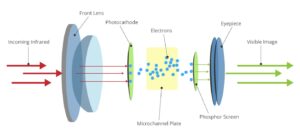
Most analog night vision glows green because the human eye is most sensitive to the green color spectrum. We can distinguish more shades and subtle details of green than any other color, which allows a user to spot a hidden animal or a tripwire in the dark much more clearly and for longer periods without straining their eyes.
Analog night vision works exceptionally well in very low-light conditions, often outperforming digital sensors in total darkness. It’s also fast, as there’s no delay or lag between what’s happening in front of the device and what you see on the screen.
On the downside, high-quality analog night vision can be expensive, and these devices tend to be heavier and bulkier. They usually don’t come with recording capabilities, zoom functions, or adjustable menus.
How Digital Night Vision Works
Digital night vision is a more modern approach, using electronic sensors similar to those found in low-light cameras. Light enters the lens, hits a CMOS or CCD sensor, and is converted into an electronic signal. That signal is processed inside the device and displayed on a screen usually an LCD or OLED.
Because it’s digital, these devices come with a range of additional features. You can often record video, take photos, adjust brightness or contrast, and even switch to daylight mode without worrying about damaging the device. Digital night vision devices are generally lighter, more affordable, and more versatile than their analog counterparts.
However, digital sensors can struggle in extremely low-light conditions. The images may appear grainy or pixelated in total darkness, and battery life can be shorter because the sensors and screens consume more power.
Digital vs Analog Night Vision: How They Compare
| Feature | Analog Night Vision | Digital Night Vision |
| Performance in darkness | Excellent — crisp, detailed images even in ultra-dark conditions | Good — may struggle in total darkness, can appear grainy |
| Speed / Response | Instant, no lag | Slight processing delays due to digital sensors |
| Reliability / Use | Trusted in professional and tactical scenarios | Flexible, feature-rich for everyday use |
| Recording & Display | Usually none | Can record video, take photos, and display information on-screen |
| Daylight Exposure | Can be damaged if exposed to bright light | Often safe, handles daylight without filters |
| Cost | High | More affordable, accessible to beginners |
| Size / Weight | Bulkier and heavier | Typically, lighter and easier to carry |
Uses of Night Vision
Wildlife Observation
Night vision allows wildlife enthusiasts and researchers to observe nocturnal animals without disturbing them. By enhancing low-light conditions, it makes it possible to study animal behavior, monitor habitats, and capture footage of creatures that are active after sunset.
Hunting
Hunters use night vision to track game in low-light conditions. It improves safety, accuracy, and efficiency by helping hunters locate and identify targets without relying on bright lights that could scare animals away.
Security and Surveillance
Night vision is essential for security personnel and homeowners who need to monitor properties at night. It enables clear visibility in darkness, helping detect intruders, unusual activity, or potential hazards without using conspicuous lighting.
Outdoor Adventures
Campers, hikers, and explorers benefit from night vision when navigating trails, setting up campsites, or observing the night environment. It enhances safety and situational awareness during nighttime outdoor activities.
Search and Rescue Operations
In emergencies, night vision equipment helps search and rescue teams locate missing persons in dark or low-visibility environments. It allows rescuers to cover large areas efficiently and safely during night operations.
Tactical and Military Applications
Military and law enforcement professionals rely on night vision for strategic operations in low-light conditions. It improves mission effectiveness, safety, and coordination during covert or nighttime tasks.
Conclusion
Digital and analog night vision each have their place. Analog is all about performance in the darkest conditions, giving you a fast, clean image. Digital brings flexibility, affordability, and extra features, making it ideal for everyday outdoor use or capturing your adventures. Understanding how each works will help you choose a device that suits your specific needs and ensures you can see clearly even when the world goes dark.
Related
- Generations of night vision explained
- Can you use thermal scopes during the day?
- Why are night vision goggles green?