
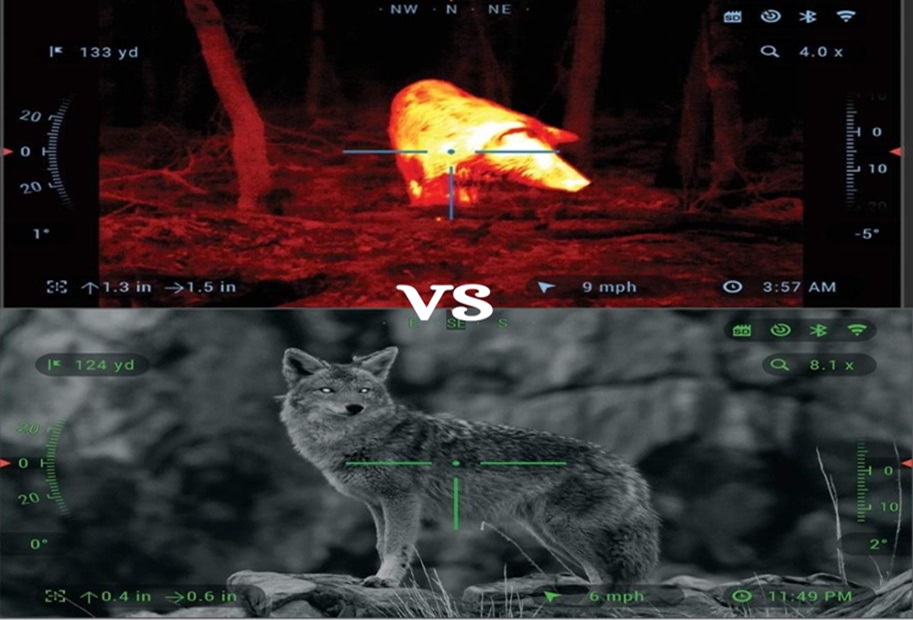
Despite their differences night vision and infrared technology are often discussed in the same breath when it comes to enhancing visibility in low-light or no-light conditions.
These two devices operate on fundamentally different principles and offer distinct advantages and limitations. This article aims to clarify these differences, helping you understand which technology might be better suited for your needs.
1) Night Vision
How Night Vision Works
Night vision devices, work by amplifying existing light, including the lower end of the infrared spectrum that’s invisible to the human eye. They collect even the tiniest amounts of light (from stars, the moon, or ambient sources) through an objective lens. The Night vision devices can either use image intensification or a CMOS ((Complementary Metal-Oxide-Semiconductor) sensor.
- Image Intensification
This is typically found in analog or traditional night vision scopes. Ambient light enters the device through the objective lens and hits a photocathode, converting photons into electrons. These electrons are then accelerated through a microchannel plate (MCP) where they’re multiplied, increasing the signal strength.
The amplified electrons hit a phosphor screen, converting them back into photons, which then create a visible image that’s much brighter than the original light input.
- CMOS
These are used in the digital night vision devices. Unlike image intensification, CMOS chips directly capture light on a CMOS sensor and convert it into an electrical charge. This signal is further processed to adjust the brightness. An example of a high-quality digital night vision scope is the ATN X-Sight Pro
Types of Night Vision
The quality of night vision devices is often categorized by generations, with Gen 1 being the most basic and Gen 3+ offering the best performance in terms of clarity, light amplification, and lifespan of the image intensifier tube.
See Also. Generations of Night Vision
Pros
- Night vision provides a high level of detail, which makes it better for target identification.
- Modern (digital) night vision is budget-friendly.
Cons
- Requires some light to function optimally. Total darkness or heavy fog can degrade performance
- NV with intensifier tubes cannot be used during the day
Night vision is good for;
- Seeing at night
- CCTV and surveillance
- Wide-angle views
- Creating images that look more natural
2) Infrared (Thermal Imaging)
Infrared devices, often called thermal imaging, detect heat (infrared radiation) emitted by objects instead of amplifying visible light. They convert the thermal energy into an electronic signal, which is then processed to produce a thermal image (thermogram).
Pros
- Works in complete darkness
- Sees through smoke, fog, foliage, and camouflage.
- It can detect living beings or heat sources even when camouflaged or hidden.
Cons
- The detail of the images might not be as sharp as with night vision.
- Pricier than night vision devices.
Infrared is good for
- Search and rescue operations, like firefighting
- Detecting warm bodies and objects over a greater distance
- Commercial inspections and surveys
- Seeing camouflaged targets
In summary;
| Feature | Night Vision | Infrared / Thermal Imaging |
| Detects | Reflected light | Emitted heat |
| Needs ambient light? | Yes | No |
| Works in total darkness? | Only with an IR illuminator | Yes |
| Can you see through smoke/fog? | Limited visibility | Very good |
| Image Type | Real images | Heat map/ thermogram |
| Price | Cheaper | Expensive |
| Good for | Navigation, ID, movement | Detection, search, tracking |
FAQs
What is an infrared illuminator?
An infrared illuminator is a device that emits invisible infrared light to help night vision equipment see in total darkness. It acts like a flashlight for night vision scopes or cameras, providing light that the human eye can’t see but that night vision sensors can detect and amplify.
What’s the best budget night vision scope?
The Sightmark Wraith HD 4-32×50 is widely considered the best budget night vision scope. It offers 1080p HD imaging, day/night modes, and an 850 nm IR illuminator for clear views in total darkness. Affordable, reliable, and easy to use.
Final Thoughts
We hope this article has perfectly covered the Difference Between Night vision and Infrared. Get more information about Night vision and infrared in the articles below.
See Also
- Types of Night Vision Devices
- Why are Night Vision Goggles Green?
- Is it Legal to Own a Night Vision Device?
- How Far Can you Shoot with a Thermal Scope?
- Generations of Night Vision (Gen 0-4)
- How Far Can You See with Night Vision Scope?