
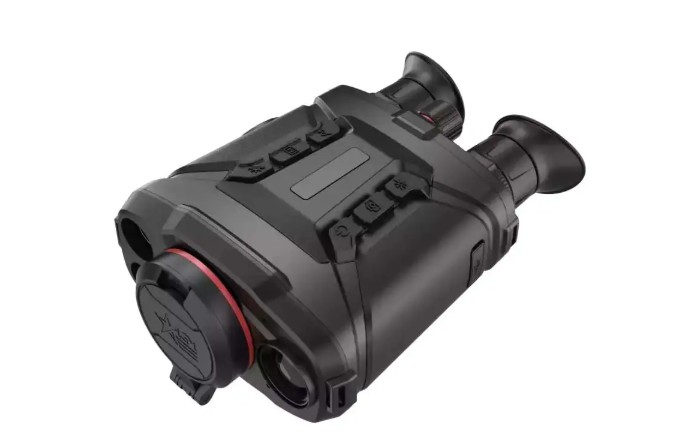
If you are looking for the top thermal binoculars in the market today, you are in the right place. In this comprehensive guide, we will share some of the important features of the best options. Read on, as we will share some of the important aspects you need to keep in mind when shopping for a reliable pair of thermal binoculars.
Thermal binoculars provide you with improved vision in low-light conditions. It also ensures that you have the best vision when there is smoke, fog, dust, or a bush.
It is important to note that thermal binoculars cost more than thermal scopes and monoculars. This is because they offer better optical performance. In addition, they are more comfortable to use because of a wide field of view.
|
Summary |
|
1. Pulsar Merger LRF XT50 |
|
2. AGM Global Vision ObservIR LRF 25-256 |
|
| 3. Guide Sensmart TN650 LRF
|
|
4 Pulsar Accolade XP50 Binoculars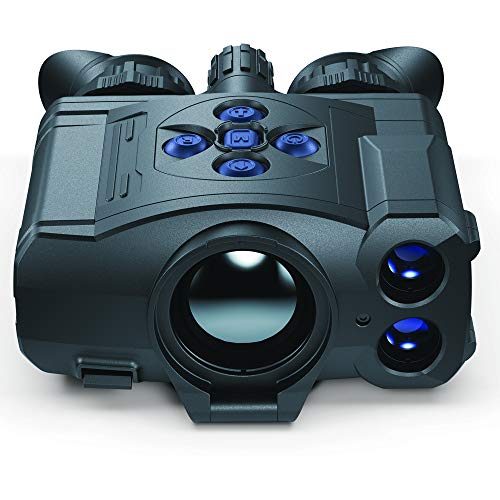 |
|
5. ATN BINOX 4T 384 Thermal Binocular |
|
4 Pulsar Accolade 2 Thermal Binocular |
|
Top Thermal Binoculars – Reviews
1) Pulsar Merger LRF XT50
If you have ever looked through a standard thermal binocular and felt like something was missing, the Pulsar Merger LRF XT50 will answer that feeling immediately. This is Pulsar at its absolute best, a European-made machine built for people who refuse to compromise.
At the heart of the XT50 is an extraordinary 1280×1024 HD thermal sensor with a 12-micron pixel pitch, delivering 66% more pixels than its predecessor, the already-excellent XL50. The result is thermal imagery so sharp and layered that you can make out antlers, track moving animals, and distinguish body shape at distances that would be invisible to lesser devices. Detection extends beyond 2,500 yards, which is genuinely staggering.
The XT50 also introduces Pulsar’s first-ever digital image stabilization, and it works. Scanning at high magnification no longer means fighting hand-shake. Pair that with a 17.5° field of view, a laser rangefinder accurate to ±1 metre out to 1,640 yards, dual battery life reaching 10 hours, IPX7 waterproofing, a magnesium alloy body, and seamless Wi-Fi connectivity via the Stream Vision 2 app, and you have arguably the finest thermal binocular available to civilian buyers today.
Pros
- Industry-leading 1280×1024 HD thermal sensor
- First Pulsar model with digital image stabilization
- Exceptional 17.5° field of view at base 2x magnification
- Precise LRF accurate to ±1m at 1,640 yards
- Up to 10-hour dual battery life
- Made entirely in Europe; 3-year warranty
Cons
- At 950g, extended handheld sessions can fatigue
- No daytime colour optical channel
- Image stabilization has a brief learning curve
2) AGM Global Vision ObservIR LRF 25-256
The AGM Global Vision ObservIR LRF is built on a genuinely different premise from most thermal binoculars: why choose between thermal and digital when you can have both? This dual-spectrum powerhouse houses a 12-micron uncooled thermal sensor with 256×192 resolution alongside a stunning 3840×2160 (4K) ultra-low-light CMOS sensor, letting you switch seamlessly between heat detection and full-colour daytime or high-contrast nighttime viewing. The thermal channel detects heat signatures out to 1,200 metres, while the digital channel delivers vivid 4K imagery with up to 4× digital zoom, a genuinely rare combination at this price.
AGM backs it with a built-in 1,000-metre eye-safe laser rangefinder, 64GB of internal storage, GPS, Wi-Fi for real-time sharing, and up to 8 hours of battery life via four removable 18650 cells. The IP67 waterproof and dustproof rating means it shrugs off rain, mud, and rough conditions. At around $1,495, it enters the thermal binocular market at a price that makes serious dual-purpose observation genuinely accessible, which is nothing short of remarkable given its feature set.
Pros
- Unique dual-spectrum: 4K digital + thermal in one unit
- Outstanding value at ~$1,495
- IP67 waterproof and dustproof
- 64GB internal storage with Wi-Fi and GPS
- Up to 8 hours battery on replaceable 18650 cells
- 1,000m eye-safe laser rangefinder included
Cons
- 256×192 thermal resolution is lower than premium rivals
- LRF reported to struggle in very cold temperatures
- Thermal detection capped at 1,200m — shorter than higher-end units
- No image stabilization
3) Guide Sensmart TN650 LRF
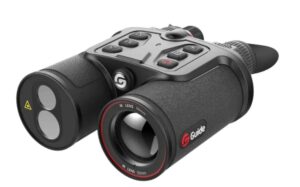
Guide Sensmart is not yet a household name in every market, but those who have used the TN650 don’t forget it quickly. This is a true binocular, dual eyepieces, dual optical paths, which means your eyes work naturally together instead of straining into a single monocular eyepiece for hours.
The core thermal sensor is a 640×480 uncooled VOx detector running at 50Hz with a 30mK NETD sensitivity rating, supported by a fast 50mm f/1.2 objective lens. Detection range reaches an impressive 2,600 metres, making this one of the farthest-reaching thermal binoculars at its price point.
The 0.39-inch AMOLED display outputs at 1024×768 with rich contrast across six colour palettes, and the magnification range of 2.8× to 22.4× is extremely versatile. An integrated 1,500-metre laser rangefinder, built-in GPS, gyroscope, compass, Bluetooth, Wi-Fi, and Micro HDMI output round out an exceptionally comprehensive feature list.
Pros
- True dual-eyepiece binocular
- 640×480 sensor with impressive 2,600m detection range
- 50Hz refresh rate for smooth tracking of moving targets
- Rich AMOLED 1024×768 display with 6 colour palettes
- Broad feature set: GPS, compass, gyroscope, HDMI out
- IP66 rated; operates from -30°C to +50°C
Cons
- Only 16GB internal storage
- Battery life of 5.5 hours is shorter than some rivals
- No image stabilization
- Less widely distributed than Pulsar or AGM
4) Pulsar Accolade XP50 Binoculars
The best thermal binoculars for long range hunting applications is the Pulsar Accolade XP50 Binoculars. It has a long detection range and powerful magnification, which makes it an ideal choice for hunters. This model can pick up the heat signature of large targets from as far as 2000 yards. It will provide you with fairly sharp image quality across the entire visual spectrum. This is because it comes with a high-resolution 640×480 thermal sensor.
The exceptional feature of this model is the Image Boost Technology. This technology helps to increase image clarity and overall quality. This is because it uses a software algorithm to increase image sharpness.
The other outstanding feature is the video recording option. It allows you to record adventures, which you can share with friends and family. It allows you to record up to 150 minutes or take 10,000 images. It has an internal memory of 8GB. You can download the medial to a computer through the USB port.
The rugged construction of this model ensures that it can stay for a very long time. It features an IPX7 weather rating. This means that it is waterproof and dustproof.
Pros
- It has a long detection range
- It has a powerful magnification
- It has a high refresh rate
Cons
- Learning curve
5) ATN BINOX 4T 384 Thermal Binocular
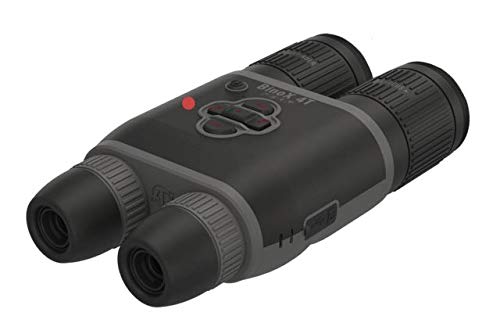
If you are in the market for a model with the longest battery life, the ATN BINOX 4T 384 Thermal Binocular is the best choice for you. This makes it an excellent choice for hunters who go on long hunting trips.
This model has over 15 hours of battery life. This means that you can use it for a long time before you need to recharge it. It is important to note that this model has two different sensor variations. It has a high resolution of 640×480 sensor and a 384×288 sensor.
In this section, we will focus on the one cheaper lower-resolution sensor. Read on, as we will also review the higher resolution sensor as well. This model has a higher refresh rate. You can zoom in between 2x and 8x and a detection range of about 1,000 yards. However, the image quality degrades when aiming at closer targets.
It comes with a built-in laser rangefinder for better shot accuracy. In addition, you can stream live video on a smartphone or tablet. The media can be stored onto the SD card that comes with this model.
Pros
- It is affordable
- It comes with a built in laser rangefinder
- It has a higher refresh rate
Cons
- Pricey
6) Pulsar Accolade 2 Thermal Binocular

If you want to get the best image quality, we recommend buying the Pulsar Accolade 2 Thermal Binocular. This model has a 4x digital zoom combined with a 2000 yard detection range.
This model is packed with many premium features to ensure you have the best viewing experience. It has a sturdy and rugged aluminum construction to ensure it lasts for a very long time. In addition, it has an IPX7 waterproof rating. It is also fog proof and dustproof.
Most enthusiasts recommend this model because it features high-quality thermal imaging sensors. It is also equipped with a resolution of 640×480 and 384×288. This model has a frost-resistant AMOLED display. This means that you can use it effectively in a wide range of temperatures.
Pros
- It has a 4x digital zoom
- It is fully IPX7 waterproof rated
- It features high-quality thermal imaging sensors
Cons
- Expensive
Factors to Consider When Buying the Best Thermal Binoculars
Before you choose any thermal binoculars, it is important to note there are some factors you need to consider.
Here are the important factors:
Resolution
The first thing you need to consider is the thermal resolution. You need to invest in a model that offers you the best quality thermal imaging. If you are on a budget, we recommend buying a model with a resolution of around 384×288. However, the images will only be clear in short to medium ranges. If you are not on a budget, we recommend buying a 640×480 pair of binoculars.
Magnification
It is important to note that the magnification depends on your glassing requirements. If you want to use it in an open field, we recommend buying a model with higher magnification. It will help you spot and track animals from a distance. However, you need to pair the right resolution and magnification. High magnification and low resolution do not go well together.
Detection Range
The sensor resolution directly affects the detection range. High-resolution sensors have a higher detection range. For instance, 640×480 sensors have a detection range of 2,000 yards or more. On the other hand, 384×288 sensors have a range of 700-1,500 yards. It is important to invest in a model with a long detection range because it will tell you which direction you need to head.
Refresh Rate
This is the number of frames the binoculars regenerate the image in a second. If the refresh rate is high, you will get smoother and more fluid images, especially when tracking a moving target. We recommend buying a pair of binoculars with a 50 Hz or 60 Hz refresh rate.
Built-in Features
Higher priced options come with additional features to improve your glassing experience. Some of these features include video recording, video streaming, and a rangefinder.
Weatherproof Design
It is important to buy a pair of binoculars with a weatherproof design. It should be waterproof and fog proof. You should be able to use it even in the harshest climatic conditions.
Battery Life
We recommend buying a model with higher battery life. This is important if you want to use it for long hunting trips. It should offer you at least 8 hours of battery life.
Warranty
It is advisable to buy a pair of binoculars that comes with an excellent warranty. We recommend buying from recognized brands that have been in the game for a long time. A model with a good warranty will provide value for the money you spend.
See Also
Conclusion
The top thermal binoculars that we have shared in this guide can effectively detect heat signatures emitted by objects. They are ideal for location scouting, hunting, security applications, and many more. They are mostly used in low-lighting situations.
In addition, they are packed with many features to provide you with the best images. This is because they have the right resolution and magnification level.
If you are still having a hard time, we recommend the Pulsar Merger LRF XT50 It is specifically designed for long-range hunting applications. It is a bit expensive, but it will deliver value for your money.