

Not long ago, thermal rifle scopes were the exclusive playground of military operators and well-funded wildlife professionals. If you were a regular hunter or predator caller, you simply watched from the sidelines. Those days are over. The budget thermal market has matured rapidly, and today you can pick up a capable, well-built thermal scope for under a thousand dollars, sometimes much less, and it will genuinely perform in the field.
That said, the market is also full of noise. Every brand claims their budget scope punches above its weight. Some are right. Some are not.
This guide cuts through the marketing to give you an honest, practical look at four of the best budget thermal rifle scopes available right now.
In This Article
- Athlon Optics Cronus ATS PRO 25P-250
- RIX Storm-S2 12μm 256
- Goyojo GRS Series 225
- AGM Global Vision Rattler V2 19-256
- ATN ThOR LTV 256 2-6×19mm
Best Budget Thermal Rifle Scopes -Reviews
1) Athlon Optics Cronus ATS PRO 25P-250
 |
Get it on Amazon and OpticsPlanet |
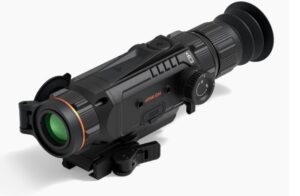
This is an excellent entry-level thermal riflescope for hunters who want dependable thermal performance without paying premium prices. Designed for hog, coyote, and predator hunting, it delivers the essential features most hunters need while remaining one of the more affordable options in the thermal market.
The scope features a 256 × 192, 12-micron thermal sensor, a 25mm F1.0 objective lens, a 50Hz refresh rate, and a 1024 × 768 OLED display. It provides 3.6x base magnification with up to 14.4x digital zoom, along with multiple color palettes, reticle options, built-in photo and video recording, Wi-Fi connectivity, and a battery system capable of delivering more than 10 hours of runtime.
In the field, the Cronus ATS PRO 25P-250 performs best at typical predator hunting distances. Heat signatures are easy to spot, allowing hunters to quickly detect animals in darkness, brush, or light fog. While the 256-resolution sensor cannot match the detail of more expensive 400- or 640-resolution models, it provides enough clarity for confident target identification and ethical shots at practical hunting ranges.
The controls are intuitive, making the scope easy to operate even in low-light conditions. Its compact, lightweight design balances well on bolt-action rifles and AR-platform firearms, while the included quick-detach mount simplifies installation.
The biggest advantage of the Cronus ATS PRO 25P-250 is its value. It offers reliable thermal imaging, modern recording features, and solid battery life at a price that makes thermal hunting accessible to more shooters. Hunters who regularly shoot beyond 250 yards may benefit from a higher-resolution model, but for most nighttime predator and hog hunting, this scope delivers dependable performance without stretching the budget.
Pros
- Excellent value for the price
- Compact and lightweight
- Reliable thermal detection at normal hunting ranges
- Smooth 50Hz refresh rate
- Long battery life
- Built-in photo and video recording
- Easy-to-use controls
Cons
- 256 × 192 sensor has limited image detail
- Digital zoom reduces image clarity
- Not ideal for long-range target identification
- Mobile app is fairly basic
2) RIX Storm-S2 12μm 256 Thermal Scope
Get it on Amazon |
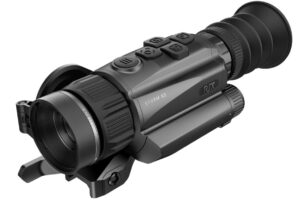
The RIX Storm-S2 has quietly built a reputation as one of the best-performing 256-resolution budget thermals on the market right now, and the reason starts with a single number, 25mK. An NETD below 25mK means the Storm-S2’s sensor is measurably more sensitive to small temperature differences than most competitors in this price range, which are typically rated at <35mK. On paper, it’s a modest difference. In practice, in foggy mornings, during warm summer nights when thermal contrast between animals and their background compresses, or when trying to distinguish a coyote resting in tall grass, that sensitivity advantage is real and tangible.
RIX compounds that sensor advantage with their proprietary Resolution Enhanced Technology, or RET. This AI-based algorithm doubles the effective pixel count through advanced interpolation, producing an image that rivals the clarity of a 384-resolution sensor. It’s not magic you’re still working from a 256×192 base, but the resulting image is noticeably sharper and more detailed than what you’d expect from the raw resolution alone. It’s one of the more honest uses of image processing you’ll find at this price tier.
The Storm-S2 is also the lightest scope in this review at just 0.9 pounds, and that’s not a trivial advantage. A thermal scope that doesn’t completely upset the balance of your rifle is a better field tool, especially over a long night of glassing and repositioning. The 25mm Germanium lens gives it a 1,422-yard detection range the longest raw detection figure in this comparison, and the 3.5× optical base magnification is a sensible starting point for most hunting distances.
Operation is refreshingly straightforward. The four-button interface with raised, tactile buttons was clearly designed with gloved hands in mind, and the on-screen indications make navigation feel intuitive even on your first night out. A unique picture-in-picture function lets you independently adjust the magnification of the PiP window separately from the main image, a feature that’s uncommon at this price, giving you situational awareness at wide field of view while zooming in on your reticle area for the actual shot.
Pros
- <25mK NETD
- RET technology sharpens 256-res images significantly
- Lightest scope here at just 0.9 lbs
- Longest detection range at 1,422 yards
- Independent PiP magnification control
- Standard 18650 battery (easy, cheap to source)
- 5-year transferable warranty with fast turnaround
- Intuitive 4-button glove-friendly interface
Cons
- Battery life (6+ hrs) is shortest of the group
- No built-in laser rangefinder
- RIX is a smaller brand with fewer dealer locations
- No shot-activated video recording
3) Goyojo GRS Series 256×192 Thermal Riflescope
Get it on Amazon |
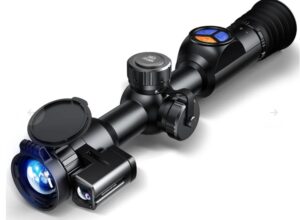
GOYOJO is a relatively young optics brand that seems to have studied the competition carefully before bringing its products to market. The GRS Series is their flagship rifle scope line, and for the money, it makes a genuinely strong first impression.
At the heart of the GRS225 is a Vanadium Oxide uncooled focal plane array delivering 256×192 resolution at a 12μm pixel pitch, with a noise equivalent temperature difference below 35mK. In practice, that sensitivity means you can pick up the heat signature of a hog tucked under a tree line at meaningful distances, even when the temperature difference between the animal and its background is subtle. The 50Hz refresh rate keeps the image smooth during tracking, and the 1440×1080 OLED display makes that image look genuinely clean, sharper than you’d expect from a scope at this price point.
The 3.5× optical zoom is a smart design decision. Many budget scopes lean entirely on digital zoom, which degrades image quality as you push it. GOYOJO’s choice to anchor the system in true optical magnification, with digital zoom extending up to 8×, gives you flexibility without throwing away sharpness when you need it most. Add in the 25mm objective lens and a 7.0°×5.3° field of view, and you have a scope that’s well-suited for predator and hog hunting at ranges up to a few hundred yards, and capable of detection well beyond that.
Recoil-Activated Video (RAV) recording automatically captures footage when you shoot, and the 32GB SD card means you won’t run out of space mid-hunt. Wi-Fi and app connectivity round things out nicely. The scope handles recoil up to 800g/0.4ms, so it’s at home on full-power rifle calibers. Battery life sits at a claimed 7–9 hours, which should cover most serious hunting sessions.
Pros
- True 3.5× optical zoom instead of purely digital
- Excellent 1440×1080 OLED display quality
- NETD <35mK, genuinely sensitive sensor
- IP67 waterproof and dustproof
- RF variant includes built-in laser rangefinder
- RAV recording and Wi-Fi app connectivity
- 7–9 hour battery life
- Impressive recoil resistance rating
Cons
- Brand is newer less long-term field data
- Smaller after-sales support network
- Limited US dealer presence compared to competitors
4) AGM Global Vision Rattler V2 19-256
Get it on Amazon |
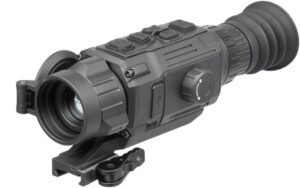
If you’ve spent any time in the thermal optics world, you know the AGM Rattler name. The original Rattler was, for a long stretch, the best-selling thermal riflescope in the United States. It offered reliable, no-fuss performance at a price point that made it accessible. The Rattler V2 19-256 builds on that foundation with improvements in nearly every area that hunters actually care about.
The most headline-grabbing upgrade is battery life. Where older budget thermals often limped along for three or four hours, the RattlerV2 carries a proprietary, removable rechargeable battery system rated at 11.5 hours of continuous use per charge, and you get two batteries in the box. That kind of runtime isn’t just convenient; it’s the difference between a confident all-night hog hunt and watching your scope die at 2 a.m. The batteries are removable and swappable in the field, which is the right design choice.
The 19mm Germanium lens gives the V2 a wider field of view than its 25mm siblings, 9.3°×6.9°, or 49 feet at 100 yards. This makes the scope particularly well-suited for close to mid-range hunting in brushy terrain where fast target acquisition matters more than extreme magnification. The 2.5× base magnification is low enough that you’re not tunnel-visioned when something moves close, and the digital zoom extends to 20× for when you need to identify a target further out.
AGM upgraded the refresh rate from 25Hz (on older Rattler models) to a smooth 50Hz, which makes a significant difference when tracking moving animals. The shot-activated recording with audio capture is a welcome addition, and the 10 reticle options with multiple zeroing profiles mean you can legitimately move this scope between different rifles without re-zeroing each time, a practical feature that doesn’t get enough credit. The raised 5-button interface sounds like a minor detail, but fumbling with sunken buttons while wearing gloves in the dark is a real problem, and AGM solved it properly here.
Pros
- Industry-leading 11.5-hour battery life
- Two batteries included out of the box
- Wide FOV ideal for close-range, fast scanning
- Upgraded to 50Hz from older 25Hz models
- Includes premium ADM QD mount
- Multiple zeroing profiles for multi-rifle use
- 5-year manufacturer’s warranty
- Established brand with strong US support
Cons
- 950-yard detection range is lowest of this group
- 19mm lens limits long-range performance
- No built-in laser rangefinder
- Proprietary battery system (not standard 18650)
5) ATN ThOR LTV 256 2-6×19mm Ultra-Light Scope
Get it on Amazon and Opticsplanet |
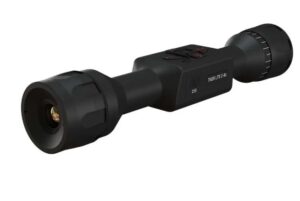
ATN has been making optics since 1995, and the ThOR LTV is the brand’s answer to the growing demand for affordable, approachable thermal scopes that feel familiar to hunters who’ve spent their lives behind traditional glass. The LTV doesn’t try to be all things to all people, it keeps things lean, intuitive, and lightweight, and in doing so, it hits a very specific sweet spot.
The most immediately notable stat on the ThOR LTV is the refresh rate. At 60Hz, it’s the fastest among the scopes reviewed here, making it the smoothest option for tracking animals in motion. When a coyote is at a dead sprint across a field and you’re trying to swing with it, those extra frames per second actually translate into a more connected, fluid tracking experience. It’s a spec that doesn’t always get the attention it deserves in budget discussions.
ATN has built their SharpIR AI image enhancement technology into the LTV, which dynamically sharpens edges and boosts thermal contrast in real time. The result is a cleaner image than the raw 256×192 sensor alone would produce. Paired with the 1280×720 HD display, the visual experience is polished and easy to work with, even for first-time thermal users. The traditional scope feel, with a 3-inch eye relief and standard 30mm ring mounting, means the transition from a conventional scope to this thermal requires almost no adjustment period.
One Shot Zero is genuinely one of the most practical zeroing systems in the industry. You fire one shot, align your on-screen reticle to where that shot landed, and you’re done. For hunters who move their scopes between platforms or who don’t want to spend a long session working up a zero, this feature alone is worth something. The internal lithium-ion battery provides over 9 hours of runtime, which is excellent for a sealed internal system, and the hardened aluminum alloy body with impact-resistant electronics is rated for use on high-caliber weapons including large-bore rifles and crossbows. ATN’s platform also offers video recording to a micro-SD card, which is a clean, simple implementation that lets you capture your hunts without overcomplicating the setup.
Pros
- Highest refresh rate of the group at 60Hz
- One Shot Zero system is fast and reliable
- Traditional scope feel hence a minimal learning curve
- SharpIR AI image enhancement onboard
- 9+ hour internal battery life
- Compatible with rifles, air rifles, and crossbows
- ATN’s established US service and support network
- Lightweight and versatile platform
Cons
- No Wi-Fi connectivity at this model tier
- No built-in laser rangefinder
- Limited to Black Hot / White Hot color palettes
- Shorter detection range due to 19mm lens
- No shot-activated recording
Thermal Scope Buying Guide
Here is everything you need to know when buying a thermal scope.
Sensor Resolution
Resolution in a thermal scope refers to how many thermal pixels the detector uses to build the image, typically expressed as width × height. All five scopes in this review use 256×192 sensors, which is the standard entry point for serious thermal work. Higher resolutions like 384×288 or 640×512 exist and cost significantly more, but for most hunting applications inside 300 yards, a good 256-resolution sensor with solid sensitivity will do exactly what you need.
What matters as much as, sometimes more than, raw resolution is the pixel pitch (measured in microns, or μm). A 12μm pixel pitch collects more detail and light per pixel than an older 17μm design, which is why modern 12μm sensors at 256×192 often outperform older 17μm sensors at the same resolution. Every scope in this guide uses 12μm sensors, which is the right call.
NETD
NETD stands for Noise Equivalent Temperature Difference, and it’s arguably the most important specification that most buyers overlook. It measures the smallest temperature difference the sensor can reliably detect, expressed in millikelvins (mK). A lower number means a more sensitive sensor.
A scope rated at <25mK (like the RIX Storm-S2) can detect subtler temperature differences than one rated at <35mK. This matters most in low-contrast scenarios, a warm animal against a warm background in summer, fog conditions, or at the transitional hours around dawn and dusk. On a cold night with clear conditions and a hot-blooded hog against cool grass, virtually any thermal will perform. It’s the marginal conditions where sensitivity separates the good from the great.
Refresh rate (measured in Hz)
This determines how many times per second the scope updates the thermal image. Budget thermals have historically offered 25Hz or 30Hz, which is acceptable for stationary or slow-moving targets but can produce a slightly choppy, laggy sensation when tracking fast animals. The scopes in this guide all run at 50Hz or higher, with the ATN LTV topping the group at 60Hz.
For predator hunting where targets can change direction quickly, a higher refresh rate translates directly into smoother tracking and a better chance of a clean shot.
Battery Life
Few things are more frustrating than a scope that dies before your hunt does. Budget thermals vary widely in runtime, from as little as 3–4 hours on older designs to 11.5 hours on the AGM Rattler V2. When evaluating battery life, also consider whether the battery is internal or removable. Internal batteries (like the ATN LTV) are convenient but mean you’re limited to a single charge without a power bank. Removable batteries mean you can carry spares and simply swap, a major advantage for all-night hunts.
Also look at the battery type. Proprietary batteries (like AGM’s NE-4400) are purpose-built for the device but cost more to replace and require the manufacturer’s charger. Standard 18650 batteries (like those used by the RIX Storm-S2) are widely available, inexpensive, and can be charged universally.
Build Quality and Waterproofing
IP67 rating means a scope can be submerged in up to 1 meter of water for 30 minutes which in practical terms means it handles rain, dew, river crossings, and being dropped in a puddle without concern. All five scopes in this review carry IP67 certification, which should be considered a minimum for any hunting thermal. Housing material also matters. Most budget scopes use aluminum alloy, which is lightweight and strong.
Connectivity, Recording, and Smart Features
Wi-Fi connectivity and companion apps have become standard on most modern budget thermals, and they add genuine value, not just marketing value. Real-time image sharing to a spotter’s phone, remote control of scope settings, and easy video review are all practically useful in the field. If a scope in your budget lacks Wi-Fi, that’s a meaningful limitation worth factoring into the decision.
Shot-activated (or recoil-activated) video recording is another feature worth seeking out. Rather than requiring you to hit record before every shot, the scope detects recoil and automatically captures the moment. This is both more reliable and less operationally distracting than manual recording. Built-in storage (via eMMC or SD card) with at least 16–32GB gives you room for a full night of recording without managing memory mid-hunt.
Brand Support and Warranty
A thermal scope is not a throwaway purchase. It should serve you for years, which makes warranty coverage and after-sales support a real consideration. Established US brands like ATN and AGM carry service networks and warranty programs that make warranty claims straightforward. Newer brands like GOYOJO and RIX offer competitive warranties but with smaller support infrastructure, not necessarily a dealbreaker, but worth factoring in.
Final Thoughts
Finding the best budget thermal scope isn’t about chasing the lowest price, it’s about getting the most value for your money. A good thermal optic should give you reliable detection, clear imaging, and solid durability without cutting corners where it matters most.
Today’s budget-friendly options have come a long way. Features that were once reserved for premium models like multiple color palettes, video recording, and decent detection ranges, are now accessible to everyday hunters, security users, and outdoor enthusiasts. The key is knowing your priorities: whether it’s longer detection range, better battery life, or a lightweight build for mobility.
That said, no budget scope will do everything perfectly. You may sacrifice some image sharpness, refresh rate, or advanced features found in high-end units, but for most real-world scenarios, a well-chosen budget thermal scope will still get the job done effectively.
Related