
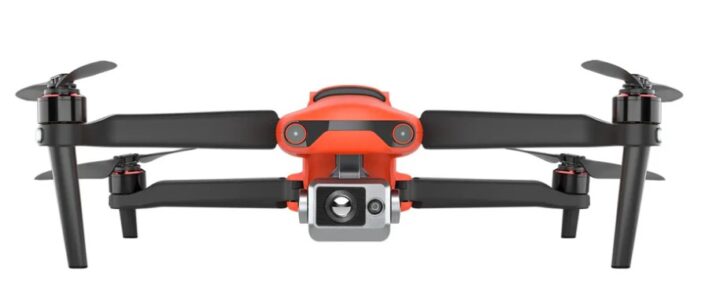
When Autel Robotics launched the EVO II Dual 640T V3, they weren’t trying to impress hobbyists. This thing was built for people who absolutely need reliable, accurate thermal data. Firefighters reading hotspots through smoke, SAR teams hunting for a missing hiker in a dense forest at 2 am, or infrastructure inspectors doing a run over a solar farm. At around $5,299 for the enterprise bundle, it’s a serious machine for serious work. But what exactly makes it stand out? Let’s break it all down.
EVO II Dual 640T V3
First Impressions & Build Quality
The moment you handle the Autel Robotics EVO II Dual 640T V3, it immediately feels like a professional-grade machine. This isn’t your typical lightweight hobby drone, it’s solid, rugged, and purpose-built for demanding environments. The construction inspires confidence, with a durable frame that can handle field work without feeling fragile. While it’s slightly bulkier than consumer drones, that extra size translates into stability and reliability where it matters most.
The drone uses a foldable design that deploys quickly, critical when you’re on a time-sensitive rescue deployment or an emergency inspection.
Thermal Capability
The star of the show is the 640 × 512 radiometric thermal sensors, and it earns every bit of that billing. Paired with a 13mm focal length lens and a 16x digital zoom, the camera can resolve thermal differences at a distance that would otherwise require you to fly dangerously close to the subject.
The new image processing algorithm Autel introduced in the V3 is a genuine upgrade thermal edges are sharper, heat gradients are more discernible, and you can actually tell a warm roof panel from a faulty one without second-guessing. Temperature measurement is equally well thought out, offering central, spot, and regional modes, plus a temperature alarm that fires a real-time alert when something hits a threshold you set. With thermal sensitivity of ≤40mK, it picks up even subtle temperature differences that cheaper sensors simply smear over. Ten color palettes, from Ironbow to Lava to Arctic, mean you can tune the visual output to whatever your workflow demands.
Image & Video Quality
Here’s something you don’t always get with thermal drones. A visual camera that’s actually worth using. With 8K video capability and 50MP still images, the level of detail is outstanding. The 50MP uses a RYYB CMOS sensor on a 0.8-inch chip. The RYYB design replaces the traditional green channel with yellow, which means it can absorb up to 40% more light in low-light conditions than a conventional RGB sensor would.
Combine that with Autel’s Moonlight Algorithm 2.0 for noise reduction, and you end up with night footage that doesn’t look like a grey fog. The camera records 4K HDR video and supports both PDAF and CDAF autofocus systems, so tracking a moving vehicle or a person on the ground is quick and accurate.
The 0.8-inch chip also offers significantly more surface area than the 1/2″ or 1/2.3″ chips you’ll find on many competitors, which directly translates to better detail retention in high-contrast daylight scenes.
Transmission Range
Range anxiety is a real thing with enterprise drones, especially when you’re operating in electrically noisy environments like industrial sites or urban cores. Autel’s SkyLink 2.0 transmission system puts that anxiety to rest. The drone maintains HD video transmission up to 9.32 miles away and supports tri-band communication across 900MHz, 2.4GHz, and 5.8GHz, with automatic frequency hopping to dodge interference.
In practice, this is an enormous advantage when you’re flying near radio towers, power infrastructure, or dense 5G coverage. The system will quietly shift to a cleaner band without you noticing, and your video feed keeps streaming. The picture-in-picture mode, which overlays thermal and visual feeds simultaneously, becomes especially powerful with this kind of reliable, high-bandwidth link, you’re never choosing between seeing the heat data or the visual scene. You see both, live, from nearly ten miles away.
Controller Experience
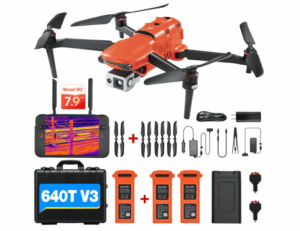
Plenty of drones ship with capable aircraft paired with frustrating controllers. Autel doesn’t make that mistake here. The included Smart Controller V3 has a 7.9-inch built-in display running at 2048×1536 resolution with a peak brightness of 2000 nits that’s four times brighter than most consumer tablets. You can absolutely read it in direct equatorial sunlight, which matters during the day.
Obstacle Avoidance
With 19 sensor groups onboard, including 12 visual sensors, ultrasonic sensors, and multiple IMUs the EVO II 640T V3 builds a real-time 3D map of its environment and plans flight paths accordingly. The obstacle avoidance system covers all directions, which is reassuring when you’re flying in complex environments where your attention is split between piloting and reading live thermal data.
The smart tracking system uses deep learning algorithms to lock onto and follow a moving subject while simultaneously avoiding obstacles genuinely useful for SAR and law enforcement operations where the target may be moving unpredictably. It won’t replace an experienced pilot’s situational awareness, but it absolutely extends how long you can operate safely when your eyes are more on the data than the sky.
Flight Time and Real-World Endurance
Autel rates the EVO II Dual 640T V3 for up to 38 minutes of flight per battery, and real-world testing suggests you can realistically hit 30–35 minutes in normal conditions. The rugged bundle typically includes three batteries, meaning a single kit can give you nearly two hours of continuous operation with hot-swapping. For a dual-payload enterprise drone carrying both a thermal and a high-res visual camera, that’s impressive.
The battery does lose some performance in cold temperatures, a known constraint across all drone batteries, so planning your charge timing matters in cooler climates. But under normal operating conditions, you’ll get consistent, predictable endurance that matches or beats most competitors at this price point.
Ease of Use
Despite its advanced capabilities, the drone is surprisingly user-friendly. The interface is well-designed, and the controls feel intuitive once you get familiar with them.
That said, beginners may need some time to fully understand all its features. This is a powerful piece of equipment, and it rewards users who take the time to learn it properly.
Pros and Cons
Pros
- Outstanding dual camera system (thermal + 50MP visual)
- 8K video and highly detailed imagery
- Excellent thermal imaging performance
- Long 38-42-minute flight time
- Strong transmission range with stable connection
- Durable, professional-grade build
- Smart controller with built-in screen
- Full 360° obstacle avoidance with real-time 3D mapping
- Rugged, fast-deploying foldable design with hard-case transport
Cons
- Bulkier than typical consumer drones
- Advanced features may overwhelm beginners
- Battery performance drops noticeably in cold conditions below 15°C
- Spare parts availability is limited in some regions
Conclusion
The Autel Robotics EVO II Dual 640T V3 is more than just a drone, it’s a powerful aerial tool built for serious work. It combines thermal intelligence with top-tier imaging and reliable flight performance in a way that few drones can match.
If you’re looking for a drone that delivers real capability, not just flashy specs, this one stands out as a top-tier choice. Whether you’re in inspections, security, or advanced outdoor use, it’s an investment that truly pays off in performance.
Related