
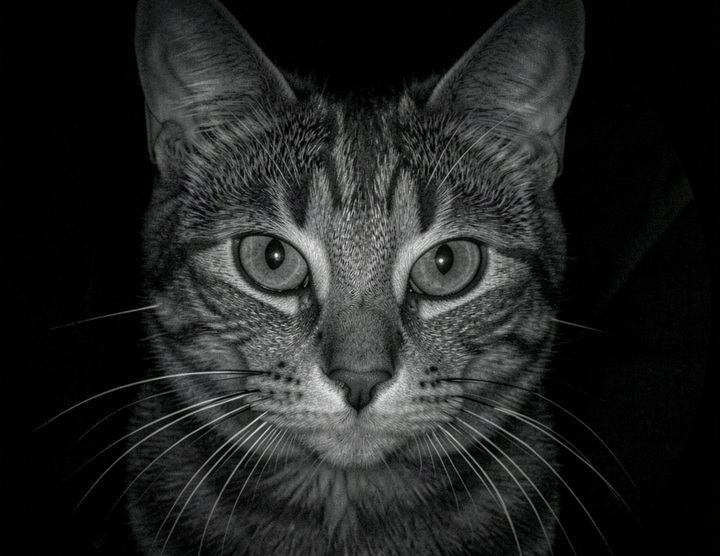
Cats have long fascinated humans with their mysterious ability to see in the dark. Walk into a dimly lit room, and you may notice your cat effortlessly navigating around furniture while you fumble for the light switch. But do cats truly have night vision? The answer is both simple and surprisingly complex.
In this article, we’ll break down how cats see in low light and the biology behind their vision.
How Do Cats See in the Dark?
Contrary to popular belief, cats do not see in complete darkness. They need at least a tiny amount of ambient light to make out shapes and movements. However, their night vision is exceptional compared to that of humans
First, cats have very large pupils that can open wide to let in as much light as possible. The more light that enters the eye, the easier it is to see in dim conditions.
Second, cats have more rod cells in their retinas. Rod cells are the parts of the eye that help detect light and movement, especially in darkness. This makes cats very good at spotting small movements at night.
Another important feature is a reflective layer behind the retina called the tapetum lucidum. This layer acts like a mirror, bouncing light back through the eye so it can be used again, effectively giving their eyes a second chance to detect light. That is why a cat’s eyes often glow when light shines on them at night.
Common Myths About Cat Night Vision
There are many myths surrounding feline night vision. Let’s separate fact from fiction:
|
Myth |
Reality |
| Cats can see in total darkness | False – they need some light to see |
| Cats see in black and white at night | Partially true – their color perception is limited in low light, but they can distinguish shades of blue and green |
| All cats have the same night vision | False – age, health, and breed can affect night vision |
| Cats can see far better than humans in daylight | False – their daytime vision is less sharp than humans’, which is why they rely on low-light advantage |
Dispelling these myths helps pet owners better understand and manage their cat’s behavior, especially in homes with poor lighting or new environments.
Cat Night Vision with Age
Kittens (0–1 year) develop good night vision within the first few months of life. By about 8–12 weeks old, their eyes are fully functional, and they can see well in low light thanks to large pupils and a fully functional tapetum lucidum.
Young adult cats (1–7 years) usually have peak night vision. During these years, their pupils adjust quickly to darkness, and their lenses remain clear. This is when their low-light vision is strongest.
Mature to senior cats (8–14 years) may begin to experience gradual changes. The lenses can slowly become less flexible and slightly cloudy. Pupil response may also slow down, making it a bit harder to see in very dim areas.
Senior cats (15+ years) may show more noticeable decline. Some develop age-related conditions such as lens clouding or other eye issues that reduce sharpness at night.
Conclusion
So, do cats have night vision? Kind of. They can see much better than humans in low light thanks to rods, vertical pupils, and the tapetum lucidum. But they’re not magical. They still need some light, and total darkness renders them as blind as we are.
Related