

Hunting has always been equal parts patience, skill, and a little luck. In the last decade, thermal drones have added a new edge: the ability to locate game by heat signature, survey terrain quickly, and scout from a safe distance with minimal disturbance.
If you’re a serious hunter aiming to up your game, a purpose-built thermal drone can transform your scouting sessions into efficient, data-driven operations, especially at dawn, dusk, or in dense cover where eyesight fails.
This guide walks you through seven of the most capable thermal drones on the market, explaining what to look for when buying one to help you choose the right setup.
At a glance;
- Autel Robotics EVO Lite 640T Enterprise
- ANZU Raptor T Enterprise Drone
- Autel Robotics EVO II Dual 640T V3
- Yuneec H520E RTK
- Autel Robotics Alpha
- Autel Robotics EVO Max 4T V2
- Parrot Anafi Thermal
Best Thermal Drone for Hunting – Top Picks
1. Autel Robotics EVO Lite 640T Enterprise
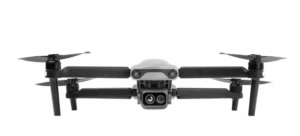
The EVO Lite 640T Enterprise is Autel’s compact enterprise-class platform built around a 640×512 radiometric thermal sensor paired with a high-resolution visible camera.
Autel packages features like radiometric temperature measurement, AI target recognition, and a 6K visible camera, giving you both crisp visual context and quantitative thermal data. The aircraft emphasizes portability, folding arms, and a light airframe while still offering strong flight times, typically 30–40 minutes, depending on payload and conditions.
Controls are intuitive and designed for field use. The unit supports enterprise accessories and configurable flight modes so you can set automated survey routes to systematically scan an area.
For hunting specifically, radiometric output matters because it lets you inspect hotspots and compare temperatures across frames. The feature is useful when determining if the flaming spot is a warm animal, a sunlit rock, or a thermal reflection. Temperature accuracy and the 16x digital zoom make it easier to validate targets before committing to a ground approach.
Pros
- Radiometric 640×512 thermal sensor
- Portable and field-friendly; good battery life for its size
- Combined 6K visible camera for situational context
- 12 km transmission range
- Comes with a 3-direction obstacle avoidance
Cons
- Requires some learning to interpret radiometric data effectively
2) ANZU Raptor T Enterprise Drone
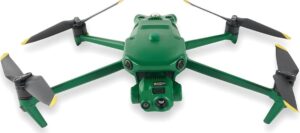
The ANZU Raptor T Enterprise Drone with Thermal Imaging stands out as a robust and portable option for commercial and specialized tasks, drawing on proven technology while prioritizing US-based security features. This foldable drone weighs around 2 pounds and measures compactly for easy transport in a backpack or vehicle, yet it packs a punch with a 640×512 pixel LWIR thermal sensor that captures detailed heat signatures alongside a 48MP wide-angle camera and 12MP tele lens offering 56x hybrid zoom.
Flight times reach up to 45 minutes on a single battery, supported by fast charging, and the omnidirectional obstacle avoidance system uses wide-angle sensors to navigate tricky environments without blind spots. The Air Control app, developed in the US by Aloft, allows seamless control, real-time streaming, and data storage on secure American servers, with no built-in geofencing to give operators flexibility while encouraging regulatory compliance. What makes the Raptor T a great thermal drone for hunting is its ability to detect game animals through heat signatures, even in low light, dense brush, or at night when traditional optics fall short.
Hunters can scout large areas quietly from afar, spotting deer, hogs, or predators without disturbing them, thanks to the long 9-mile transmission range and extended battery life for thorough coverage of remote terrain. The thermal radiometry measures temperatures accurately, helping identify live animals versus environmental heat, while the zoom lets users confirm targets ethically before approaching. Low-light mode enhances visibility during dawn or dusk hunts, and RTK positioning ensures precise mapping of animal trails or recovery of downed game.
Pros
- High-resolution 640×512 with radiometry and multiple color palettes
- Up to 45-minute flight time
- 56x hybrid zoom and split-screen capabilities
- Portable, foldable design under 2 pounds
- US-developed software with secure data storage and no geofencing
- RTK module for centimeter-level positioning accuracy
- Low-light mode for dim conditions
Cons
- Higher price point compared to similar DJI models
- Software can be buggy in early versions, especially for mapping
3. Autel Robotics EVO II Dual 640T V3
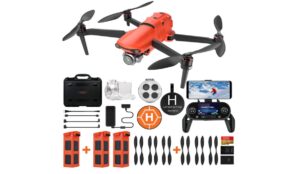
The EVO II Dual 640T V3 is designed for hunters who want a single platform for mapping, evidence-gathering, and thermal scouting.
It brings a robust dual-sensor setup. A high-res visible sensor (up to 48MP stills and 8K video capability) coupled with a 640×512 thermal sensor. This configuration makes the V3 a versatile field tool that captures crisp, detailed imagery for maps and documentation while simultaneously collecting thermal data for live scouting.
The thermal payload often features a 13mm focal length and strong digital zoom, making it easier to differentiate distant heat signatures. The V3 is built for enterprise tasks but adapts well to hunting.
Flight performance is competitive, with intelligent flight modes and obstacle avoidance designed to reduce risk during low-altitude passes in mixed forestry.
The combination of thermal and ultra-high-resolution visible imaging lets you archive sightings and create storyboards for patterns over time, say, how deer use a creek bank at night, which helps with long-term planning.
Pros
- Robust Dual high-res visual + 640×512 thermal sensor
- Excellent imaging for documentation and mapping
- Enterprise features like advanced flight modes and image fusion
- 19 groups of sensors enhance flight capability.
- Different configurations to choose from.
Cons
- Larger and less pocketable than ultra-compact models
- Not for casual hunters.
4. Yuneec H520E RTK
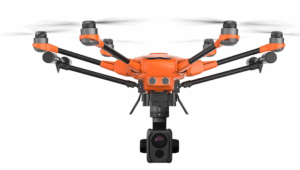
The Yuneec H520E RTK is a hexacopter designed for heavy-duty enterprise work extended stability in gusty conditions, hot-swappable payloads, and optional RTK positioning for centimeter-level accuracy. For hunters operating across varied elevations and dense cover, the H520E’s stability is a major advantage.
Smoother flight equals clearer thermal frames, especially when using telephoto or narrow-field thermal sensors. The camera also allows independent control of the copter and camera, via different remote systems.
H520E’s features include multiple rotor fail-safe modes, mission planning through Yuneec’s DataPilot, and an integrated ground control station experience for systematic corridor or grid searches. Updating the drone’s software is done easily on the Google Play Store, so you will always stay up to date for peak performance.
Pros
- Hexacopter redundancy and stability in wind
- Hot-swappable cameras/payload flexibility
- Integrated mission planning and RTK option for precision
- Software dev kit for developers.
Cons
- Bulkier, more logistical overhead than compact drones
5. Autel Robotics Alpha
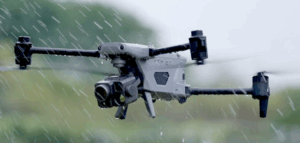
Autel’s Alpha series targets serious enterprise users and stands out with exceptional thermal zoom capability. Depending on the configuration, the Alpha offers a dual-thermal zoom system with high magnification and a powerful visible zoom.
For hunters who need to identify animal species or behavior at, the Alpha’s ability to bring small targets into view without closing distance is a distinct advantage.
The platform is built for heavy usage: IP55 weather rating, hot-swappable batteries, multiple redundancy features, and an open architecture for payload expansion.
Operationally, the Alpha is designed with a capability for long flight windows, robust GNSS and anti-interference design, and omnidirectional obstacle avoidance, improving safety when scanning complex landscapes.
If your hunting grounds are large, remote, and require long standoffs to avoid spooking game, the Alpha provides the optical reach and thermal sensitivity needed to conduct high-confidence reconnaissance
Pros
- Exceptional thermal and visual zoom
- Weather-resistant, modular, and built for heavy-duty use
- Hot-swappable batteries and robust comms for extended ops
Cons
- Enterprise price point and complexity
6. Autel Robotics EVO Max 4T V2 Rugged Bundle
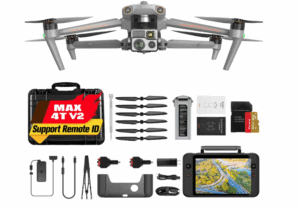
The EVO Max 4T V2 Rugged Bundle is positioned as a tactical/enterprise-grade multi-sensor platform. It typically includes a 4-in-1 camera array, wide, zoom, thermal, and low-light sensors, plus ruggedized features like IP43 weather resistance, hot-swappable batteries, and advanced obstacle perception.
What makes this model appealing to hunters is its all-in-one nature. You don’t need to swap payloads to switch from broad-area search to focused thermal inspection.
The thermal element combines with an optical zoom and an 8K-capable visible camera, enabling documentation and long-distance identification without multiple flights.
Rugged bundles are often sold with reinforced cases, additional batteries, and enterprise-grade controllers, which reduce field downtime and protect equipment from the elements, a strong advantage if you routinely fly in wet or dusty environments.
The Max 4T also markets extended transmission range and low latency, which improves situational awareness during complex scouting missions.
Pros
- Multi-sensor versatility in one platform
- Rugged features for real-world, harsh environments
- Hot-swappable batteries and extended comms for longer ops
Cons
- More features than some users will ever need
- Size and case logistics for transport
7. Parrot Anafi Thermal
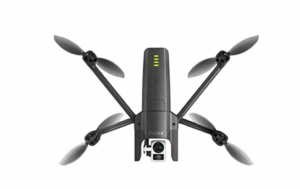
If you need a lightweight and budget-friendly thermal scope to use for hunting then this is the best option on the market right now.
The Anafi Thermal is compact, when folded, lightweight (315 g), and offers practical flight times around 20–26 minutes.
Its thermal sensor is paired with a 4K visible camera and a 2.8× optical zoom on the visible, ideal for hunters who want a near-silent, easily transported option for quick scouting.
Operationally, the Anafi Thermal is straightforward, fast to deploy, easy to fly, and less intimidating to use than heavy enterprise kits.
The thermal imagery is suitable for close-to-medium-range detection. It’s not meant for kilometer-scale surveillance or precision radiometric measurements, but as a practical, legal-friendly, and budget-conscious thermal scouting tool, it does the job well.
Pros
- Very portable and quick to deploy
- Affordable relative to enterprise thermal systems
- Good for close-to-midrange scouting and situational awareness
Cons
- Shorter flight time and smaller thermal sensor than enterprise drones
- Less rugged for extreme conditions
Thermal Drone for Hunting -Buying Guide
Thermal sensor resolution and radiometry
Thermal resolution dictates how much thermal detail appears in an image at range. A 640×512 sensor delivers far more useful detail than a 160×120 module, meaning smaller animals, partial signatures through light cover, and subtle temperature differences become interpretable.
Radiometry means each pixel stores temperature information; that’s useful when you want to compare hot spots frame-to-frame or create objective recordings for later analysis. For hunting, higher thermal resolution and radiometric capability make identification and patterning far easier, but they also push cost up.
Field of view (FOV) and focal length
FOV and focal length control how much ground you see and how large targets appear. Wide FOVs help you sweep quickly across open fields and ridgelines, while narrow FOVs let you resolve targets at distance.
When hunting, start with a wide sweep to locate hotspots, then switch to a narrower lens or zoom to identify the target. Digital zoom helps, but loses detail. Optical or multi-lens thermal systems are superior when long-range ID matters.
Flight time and battery logistics
A drone’s advertised flight time is a planning baseline. For hunting, you need to consider practical sortie length, how many batteries you carry, and how temperature affects battery performance.
Cold mornings and nights reduce capacity, so carry extra batteries and a plan to keep them warm. Hot-swappable batteries or quick-change systems save time.
Range, latency, and transmission stability
Transmission range and video latency determine how far you can scout while retaining real-time control and clear imagery. Low latency is especially important for tracking moving game or making precise identification decisions.
However, legal line-of-sight rules and local aviation restrictions often limit how far you may fly, so prioritize stable, interference-resistant links and plan missions that keep the craft within legal and safe limits.
Gimbal stabilization and image quality
A well-stabilized gimbal reduces frame jitter, creating clearer thermal and visual frames that make it easier to identify animals.
If you intend to create documentation or analyze behavior later, higher visual resolution paired with stable thermal frames matters. Unstable footage can render even high-resolution thermal sensors less useful because motion blur and vibration obscure small heat signatures.
Ruggedness and weather resistance
Hunting is messy; therefore, an IP-rated drone or a model marketed as rugged will better survive real conditions.
Weather resistance reduces the risk of a mission-ending malfunction and expands the windows when you can legally and safely fly.
Payload flexibility and modularity
If you want one drone to do multiple jobs, thermal sweeps, long-range ID, mapping, or even carrying a small light for operational work, choose a platform with payload options. Modular platforms let you swap different components, increasing the utility.
Legal, ethical, and safety considerations
Many jurisdictions require line-of-sight operation, restrict night flights, or prohibit hunting-related drone use. Even where legal, consider the ethics. Use drones primarily for scouting, safety, and management, and adhere to local rules and fair chase principles.
See Also: Night hunting laws
Thermal drones for hunting – FAQs
Are thermal drones legal to use for hunting?
Legality varies substantially by jurisdiction. In many places, using a drone to locate or directly assist in taking wildlife is illegal. Other areas allow scouting so long as you don’t use the drone to directly guide the kill.
Always consult state/provincial and local wildlife regulations before using a drone in the field. Ignorance of the law can result in fines or loss of hunting privileges, so treat regulatory research as part of your gear checklist.
How far can I reliably identify an animal with a thermal drone?
Identification range depends on thermal sensor resolution, lens focal length, atmospheric conditions, and the animal’s size and thermal contrast.
A 640×512 thermal with a telephoto lens can identify medium-sized animals at several hundred meters in good conditions; smaller sensors will have much shorter effective ID ranges. Vegetation, humidity, and weather reduce the effective range. Plan for conservative standoff distances during real-world scouting.
Do I need radiometric thermal imaging to be useful for hunting?
Radiometry is valuable because it provides temperature measurements rather than just a heat picture. That can help with objective comparisons, repeated monitoring, and documentation.
For casual scouting where you just want to spot heat contrasting against the environment, non-radiometric thermal is often sufficient. If you need precise measurement for research, livestock checks, or repeatable monitoring, radiometry is worth the extra cost.
Will drones spook game?
Yes, drones can spook animals, especially at low altitude or with loud propeller noise. Use higher standoffs and long-range identification where possible, fly quietly, and approach from angles less likely to alarm wildlife.
Many hunters use drones only to locate animals, then approach by foot or vehicle from a different direction to reduce disturbance.
What’s the best time of day to use a thermal drone for hunting?
Dawn and dusk are ideal because animal body temperature contrasts with ambient air or ground temperatures are typically highest, making detection easier.
Night can also work, but legal restrictions and safety concerns increase. Midday thermal contrast is often reduced by sun-heated ground and rocks, making detection harder. Plan flights around the thermal behavior of the species you track and local regulations.
How should I carry and charge batteries in cold weather?
Cold drastically reduces battery capacity. Keep spare batteries warm in an insulated pouch or inside your clothing until you’re ready to swap them.
Cycle batteries indoors before heading out, and rotate usage so no pack stays cold for too long. Consider carrying more batteries than you expect to need and test your system in cold conditions before relying on it for an important hunt.
Can I use thermal drones to find wounded game?
Thermal imaging can be a valuable aid in finding wounded animals by detecting heat signatures through light cover or at night. However, responsibility and legal frameworks apply: you must follow local laws about searching with electronic aids and practice humane tracking and dispatch. Use thermal technology to minimize suffering and to locate animals for quick, humane resolution rather than to extend pursuit unfairly.
Final thoughts
This article reviews the best thermal drones for hunting, and every drone included here is guaranteed to give you valuable performance. No matter which platform you choose, pair it with clear knowledge of local laws, a responsible hunting ethic, and thorough practice flying in the exact terrain and seasonal conditions where you hunt.
Related